Information security has become a strategic priority for organizations operating in software development, IT services, manufacturing, financial services, telecommunications, healthcare, and other data-driven industries. Increasing cybersecurity threats, regulatory obligations, customer expectations, and complex supply chains require organizations to establish reliable security practices that protect information and support business continuity.
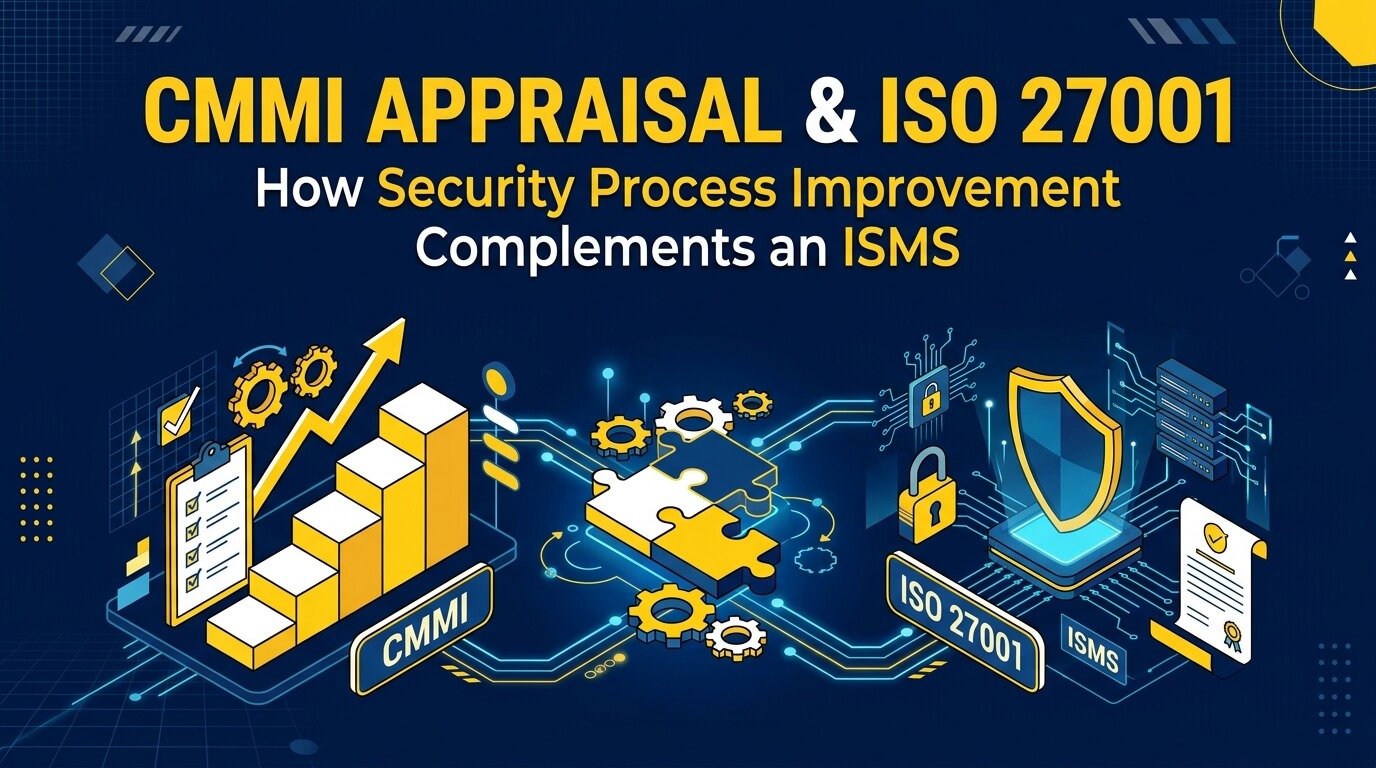
ISO/IEC 27001 and the Capability Maturity Model Integration (CMMI) framework can help organizations address different aspects of this challenge. ISO/IEC 27001 provides requirements for establishing and continually improving an Information Security Management System (ISMS), while a CMMI appraisal evaluates organizational processes against the applicable CMMI model and appraisal scope.
When used appropriately, these approaches can complement each other. An ISO/IEC 27001-based ISMS establishes a structured approach to information security governance and risk management, while CMMI-related process improvement can help organizations strengthen the consistency, implementation, and performance of relevant security activities.
This article explores the relationship between CMMI appraisal and ISO 27001, explains how security process improvement can support an ISMS, and outlines practical considerations for organizations seeking stronger security management and operational performance.
Understanding CMMI Appraisal
Capability Maturity Model Integration, commonly known as CMMI, is a framework that helps organizations improve their processes, capabilities, and business performance. It provides structured best practices that organizations can use to evaluate existing processes, identify improvement opportunities, and develop more consistent ways of working.
A CMMI appraisal is a formal evaluation conducted under the applicable CMMI model and appraisal method. It examines relevant organizational processes and supporting evidence to determine how the organization performs against the model's applicable expectations within the defined scope.
Depending on the selected model, version, and appraisal scope, the evaluation may cover areas such as planning, monitoring, quality management, risk management, measurement, organizational process management, and security-related practices.
Organizations use CMMI-related assessments and improvement activities to understand process weaknesses, improve operational consistency, strengthen accountability, and support measurable performance objectives. A formal appraisal outcome depends on the applicable method, evidence, scope, and evaluation results; it should not be assumed from the implementation of selected practices alone.
Understanding ISO/IEC 27001 and an ISMS
ISO/IEC 27001 is an internationally recognized standard specifying requirements for establishing, implementing, maintaining, and continually improving an Information Security Management System. ISO/IEC 27001:2022 is the published 2022 edition of the standard, with a 2024 climate action amendment relevant to the management-system context.
An ISMS provides a systematic framework for identifying information security risks, determining suitable treatments, assigning responsibilities, implementing controls, evaluating performance, and improving security management over time.
Its scope may include information systems, business applications, cloud infrastructure, employee information, customer records, intellectual property, physical documents, supplier relationships, and other information assets relevant to the organization.
An effective ISMS supports three essential information security objectives:
- Confidentiality: Preventing unauthorized access to or disclosure of sensitive information.
- Integrity: Protecting information against unauthorized modification, loss of accuracy, or inappropriate destruction.
- Availability: Ensuring that authorized users can access information and services when required.
ISO/IEC 27001 also emphasizes organizational context, leadership, planning, support, operation, performance evaluation, and improvement. Annex A provides a reference set of information security controls that organizations consider during risk treatment and the preparation of their Statement of Applicability. Control selection should reflect the organization's risks, obligations, and ISMS scope rather than being treated as an identical checklist for every organization.
CMMI Appraisal vs. ISO 27001 Certification
Although CMMI appraisal and ISO 27001 certification can support organizational improvement, they are not the same process. Understanding their differences helps organizations establish appropriate objectives and avoid duplicating activities unnecessarily.
ISO/IEC 27001 certification involves an independent certification body's assessment of whether the organization's ISMS conforms to the applicable standard within the defined certification scope. The audit evaluates the management system, including relevant risk management arrangements, documented information, operational implementation, and performance evaluation.
A CMMI appraisal evaluates processes against the selected CMMI model and applicable appraisal method. Its scope and results depend on the relevant model, organizational boundaries, appraisal requirements, and evidence reviewed by the authorized appraisal team.
The key differences include:
- Primary purpose: ISO/IEC 27001 focuses on conformity of an ISMS with defined requirements, while CMMI focuses on process capabilities and organizational performance against its applicable model.
- Evaluation approach: ISO/IEC 27001 certification follows the applicable management-system certification process; a CMMI appraisal follows the relevant CMMI appraisal method.
- Results: ISO/IEC 27001 can lead to an ISMS certificate when certification requirements are met. A CMMI appraisal may establish an applicable maturity or capability outcome when supported by the formal appraisal results.
- Areas of emphasis: ISO/IEC 27001 establishes information security management requirements, while CMMI can help organizations evaluate and improve the processes relevant to their selected model.
Neither outcome automatically grants the other. ISO/IEC 27001 certification does not establish a CMMI maturity level, and a CMMI appraisal does not demonstrate ISO/IEC 27001 conformity by itself.
How CMMI Appraisal Complements an ISO 27001 ISMS
1. Strengthening Security Process Implementation
An ISO/IEC 27001-based ISMS establishes the requirements and governance structure for managing information security risks. However, policies and procedures must also be implemented consistently across the relevant teams and business activities.
CMMI-related process improvement can help organizations examine how security activities are planned, executed, monitored, and improved. A structured review can identify inconsistent procedures, unclear responsibilities, missing records, and weaknesses in the way employees perform security-related tasks.
Example: An organization has a documented access control policy but discovers that different departments perform user access reviews at different intervals. Process improvement can help establish clear ownership, consistent review procedures, exception handling, and follow-up mechanisms that support the ISMS objectives.
2. Improving Information Security Risk Management
Risk assessment and risk treatment are central to ISO/IEC 27001. Organizations must understand relevant information security risks and determine appropriate responses based on their established criteria, business objectives, and obligations.
CMMI-related process improvement can strengthen the consistency of risk identification, analysis, communication, escalation, and monitoring across organizational activities. This can be especially valuable for companies managing multiple software projects, outsourced services, cloud environments, or complex supplier relationships.
For example, a company may identify vulnerabilities in a business-critical application. A coordinated approach can connect the ISMS risk assessment with a repeatable workflow for recording findings, assigning remediation owners, setting risk-based priorities, verifying corrective actions, and reviewing residual risk.
The objective is to improve the execution of risk management activities while retaining the ISMS's established risk assessment and treatment methodology.
3. Strengthening Security Governance and Accountability
Effective security management requires clear accountability. Management, IT teams, information security personnel, process owners, employees, and external providers may all have responsibilities that affect the organization's security posture.
ISO/IEC 27001 supports the establishment of management responsibilities and relevant organizational arrangements. CMMI process improvement can complement this by helping organizations clarify how responsibilities are translated into repeatable work practices and measurable activities.
Defined ownership can improve decision-making, escalation, evidence collection, and the completion of corrective actions. It also helps reduce situations in which important security tasks remain unfinished because different teams assume that another department is responsible.
4. Improving Security Incident Management
Security incidents can lead to service interruptions, data exposure, financial loss, reputational damage, and contractual consequences. An ISMS establishes the management arrangements for addressing relevant information security incidents and improving the organization's response capability.
CMMI-oriented improvement can help strengthen the processes used to report, classify, escalate, investigate, resolve, and review incidents. It can also encourage organizations to examine recurring problems and implement corrective actions that address their underlying causes.
For instance, repeated phishing incidents may indicate that awareness activities, reporting mechanisms, technical controls, or response procedures need improvement. Reviewing these issues systematically can help the organization determine whether its corrective actions are effective rather than simply recording each incident as an isolated event.
5. Enhancing Measurement and Performance Evaluation
ISO/IEC 27001 requires organizations to evaluate the performance and effectiveness of their ISMS. Appropriate measures help management understand whether security objectives are being achieved and whether planned activities are delivering the intended results.
CMMI-related improvement can support a more systematic approach to measuring process performance, identifying recurring weaknesses, and using results to guide decisions. Rather than collecting data solely for reporting purposes, organizations can use relevant indicators to improve the execution of security activities.
Examples of useful indicators include:
- Percentage of scheduled access reviews completed within the required timeframe.
- Time taken to remediate vulnerabilities according to their risk classification and defined targets.
- Incident reporting and escalation times.
- Number and age of outstanding corrective actions.
- Completion and effectiveness of relevant security training.
- Recurring security findings identified through audits and operational reviews.
Organizations should select indicators that relate directly to their information security risks and business objectives. Measurements should support meaningful decisions instead of encouraging teams to focus on numerical targets without improving actual security outcomes.
6. Supporting Supplier and Third-Party Security
External suppliers and service providers can introduce information security risks through their access to systems, data, infrastructure, and business operations. Organizations therefore need appropriate arrangements for assessing and managing relevant third-party risks.
An ISO/IEC 27001 ISMS provides a risk-based management structure for addressing supplier-related security concerns. CMMI-related process improvement can help make supplier assessments, issue tracking, remediation follow-up, and periodic reviews more consistent.
A coordinated process can help ensure that supplier security is considered throughout the relationship, from initial selection and onboarding to ongoing monitoring and contract termination where appropriate.
7. Supporting Continual Improvement
Information security threats, business priorities, technologies, and regulatory expectations change over time. An effective ISMS must therefore remain responsive to changing conditions rather than relying on a static set of policies and controls.
CMMI-related process improvement can reinforce this objective by encouraging organizations to identify process weaknesses, analyze their causes, prioritize improvements, and monitor results. The ISMS provides the governance context, while process improvement supports the development of more consistent operational practices.
This coordinated approach helps organizations treat security improvement as an ongoing management responsibility rather than an activity performed only before an audit or appraisal.
Practical Steps for Aligning CMMI Appraisal with ISO 27001
Step 1: Define the ISMS and Appraisal Scope
Identify the business units, systems, locations, services, projects, and information assets included in the ISMS. Separately establish the intended CMMI model, version, appraisal scope, and improvement objectives. The scopes may overlap, but they should not be assumed to be identical.
Step 2: Conduct a Baseline Assessment
Review existing policies, procedures, risk assessments, security controls, operational records, performance indicators, and corrective actions. Determine whether processes are implemented consistently and whether the available evidence supports the organization's stated practices.
A gap analysis can identify weaknesses in process ownership, implementation, risk management, monitoring, and continual improvement. Findings should be documented clearly and prioritized according to their significance.
Step 3: Map Related Processes and Requirements
Identify opportunities to coordinate related activities, such as risk management, incident response, supplier security, measurement, and corrective action. Use the applicable CMMI model documentation and ISO/IEC 27001 requirements to confirm the relationship between individual practices.
Avoid treating a general process mapping exercise as proof of conformity. Each framework has its own evaluation criteria and evidence expectations.
Step 4: Develop and Implement an Improvement Plan
Assign responsibilities, define realistic deadlines, allocate resources, and establish measurable outcomes for each priority. Address the underlying causes of weaknesses and ensure that revised procedures are incorporated into actual operational activities.
Provide appropriate training so that employees understand the updated processes and can demonstrate their implementation in their normal work.
Step 5: Verify Implementation and Monitor Results
Review relevant records, process outputs, performance measures, and corrective actions to determine whether improvements are working as intended. Maintain authentic evidence of actual activities and avoid creating retrospective documentation merely to satisfy an anticipated assessment.
Management reviews and internal audits can help identify remaining weaknesses and determine whether additional actions are required before the relevant certification audit or CMMI appraisal.
Step 6: Prepare for the Appropriate Formal Evaluation
Organizations should coordinate ISO/IEC 27001 certification activities with an appropriately accredited certification body where applicable and arrange CMMI appraisal activities through the authorized CMMI appraisal process. Each evaluation must follow its own applicable requirements and procedures.
Preparation should focus on genuine implementation, clear responsibilities, reliable evidence, and effective processes rather than attempting to guarantee a particular outcome.
Common Challenges When Combining CMMI and ISO 27001
Organizations may encounter several challenges when aligning process improvement with an existing ISMS. Recognizing these issues early can help reduce unnecessary effort and improve implementation quality.
- Duplicated documentation: Separate teams may create overlapping procedures and records. Coordinated document management can reduce unnecessary duplication while preserving framework-specific requirements.
- Unclear responsibilities: Security tasks may be distributed across departments without clear ownership. Defined responsibilities and escalation paths help address this issue.
- Limited employee awareness: Employees may understand written policies but lack practical knowledge of the procedures they must follow. Role-based training can improve implementation.
- Insufficient management commitment: Process improvements may stall without resources, leadership involvement, and appropriate oversight.
- Compliance-focused behavior: Teams may prioritize preparing documents for an evaluation instead of improving daily security performance. Monitoring actual work practices helps maintain a practical focus.
- Unrealistic timelines: Organizations may underestimate the time needed to implement changes and establish reliable evidence. A risk-based roadmap supports more realistic planning.
Successful integration requires clear objectives, appropriate expertise, management support, and a commitment to continual improvement. The aim is to coordinate related activities without confusing the distinct requirements of the two frameworks.
Business Benefits of Combining CMMI Appraisal and ISO 27001
When appropriately implemented, an ISO/IEC 27001 ISMS and CMMI-related process improvement activities can support a more consistent and measurable approach to organizational security.
Potential benefits include improved visibility of security risks, stronger process ownership, more consistent operational controls, better incident management, and more effective corrective actions. Organizations may also gain a clearer understanding of their process weaknesses and the resources needed to address them.
A coordinated approach can support customer confidence, supplier assurance, business continuity objectives, and organizational resilience. It may also help organizations reduce redundant activities by using suitable shared processes and records where permitted.
However, these benefits depend on implementation quality and the organization's business context. Neither framework eliminates all cybersecurity threats, and using both does not automatically establish compliance, certification, or a specific CMMI appraisal outcome.
Conclusion
CMMI appraisal and ISO/IEC 27001 can complement each other by addressing different but related aspects of organizational performance and information security. ISO/IEC 27001 provides requirements for an ISMS that manages information security risks, while CMMI-related assessment and improvement activities can help organizations evaluate and strengthen the processes through which security objectives are achieved.
By aligning security governance with disciplined process implementation, organizations can improve risk visibility, clarify accountability, strengthen incident management, and use performance information to guide ongoing improvements. The value comes from implementing effective practices, not simply from maintaining documentation or pursuing formal evaluation outcomes.
Organizations planning to strengthen both their ISMS and operational security processes should begin with a clear scope, a realistic gap analysis, and a prioritized improvement roadmap. With appropriate expertise and management commitment, the combined approach can support more reliable security operations and sustainable organizational performance.
Strengthen Your Security Processes with B-ADVANCY
B-ADVANCY Certification Limited supports organizations through management system consulting, cybersecurity and compliance-related services, professional training, and process improvement support. Businesses seeking to strengthen their information security management practices can discuss their objectives, existing challenges, and relevant assessment requirements with the B-ADVANCY team.
Whether your organization is developing an ISO/IEC 27001-based ISMS, improving existing security processes, or preparing for CMMI-related assessment activities, a structured approach can help identify improvement priorities and support long-term business objectives.
📞 WhatsApp:Chat on WhatsApp📧 Email:info@b-advancy.com


 Contact For Services
 Explore Training Calendar