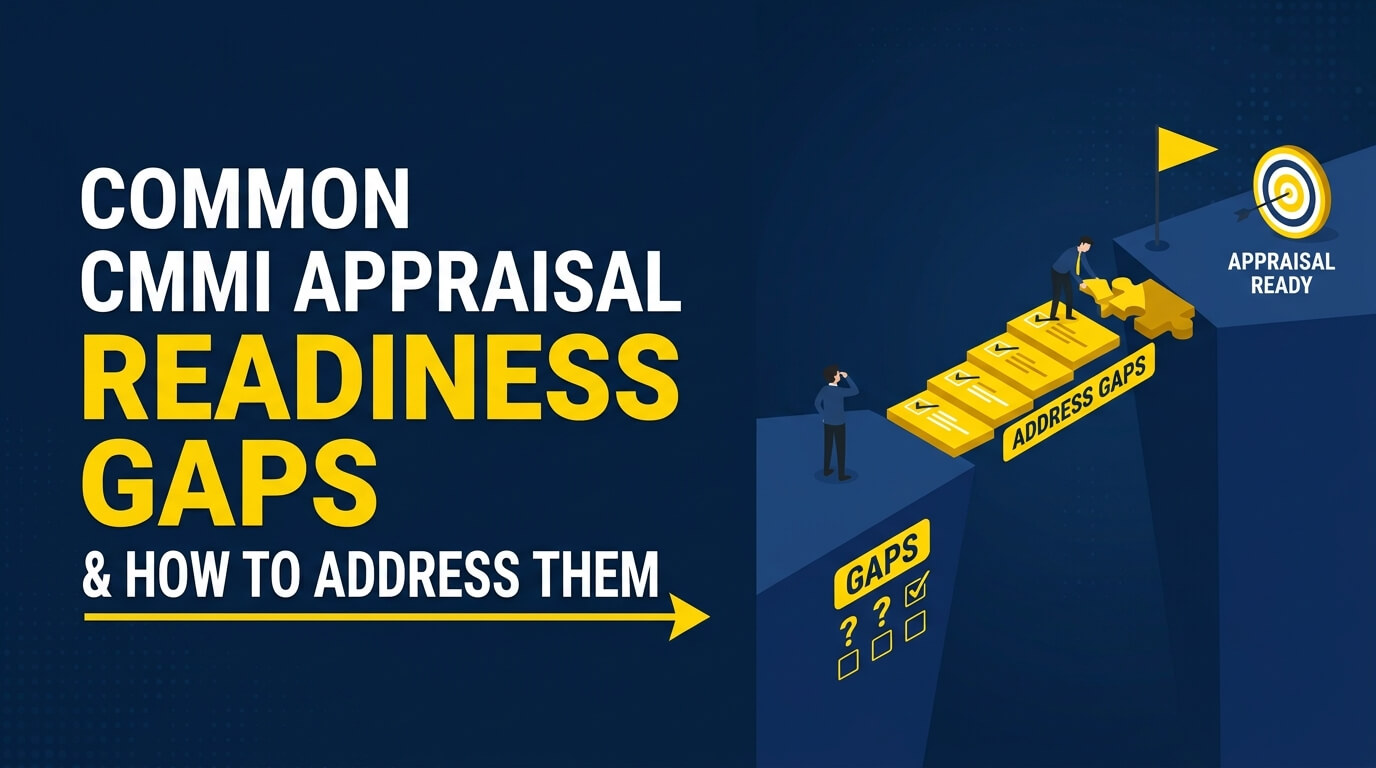
For software development companies, IT service providers, engineering organizations, and other technology-driven businesses, appraisal readiness should be treated as a structured improvement activity rather than a documentation exercise. A successful preparation programme connects business objectives with daily working practices, validates implementation across the intended organizational scope, and ensures that relevant evidence accurately reflects how work is performed. This article explores the most common CMMI appraisal readiness gaps and practical ways to address them before an appraisal begins.
What Is CMMI Appraisal Readiness?
CMMI appraisal readiness refers to the extent to which an organization is prepared to demonstrate that its processes align with the applicable CMMI model requirements and the expectations of the selected appraisal method. Readiness involves reviewing organizational practices, confirming the appraisal scope, identifying process weaknesses, validating implementation, and ensuring that the necessary evidence is available and reliable.
The preparation process should consider both documented procedures and actual execution. A process may appear complete on paper but still have significant gaps if employees do not follow it consistently, project records are missing, responsibilities are unclear, or performance information is not used effectively.
Organizations should establish their readiness approach using the applicable CMMI model version, appraisal type, organizational scope, and current appraisal rules. Requirements and evidence expectations may differ depending on these factors, so a generic checklist should not replace guidance from an appropriately authorized CMMI appraisal professional.
For official information about CMMI appraisal approaches, visit the CMMI Institute Appraisals page.
Why CMMI Appraisal Readiness Gaps Occur
Readiness gaps often develop when organizations prioritize the desired appraisal result over sustainable process improvement. Some companies begin preparing shortly before a planned appraisal, while others develop extensive documentation without ensuring that employees use it in real projects. Rapid organizational growth, employee turnover, limited management involvement, and inconsistent project practices can also weaken implementation.
Common contributing factors include:
- Unclear understanding of the applicable CMMI model and appraisal scope.
- Process documentation that does not reflect actual organizational practices.
- Inconsistent implementation across projects, teams, or organizational units.
- Insufficient objective evidence or difficulty tracing records to specific work activities.
- Limited employee awareness of process responsibilities and expected practices.
- Weak performance measurement, risk management, and corrective action processes.
- Insufficient time for internal reviews and verification of corrective actions.
Recognizing these causes helps management develop a readiness plan that addresses underlying weaknesses instead of applying temporary fixes immediately before the appraisal.
Common CMMI Appraisal Readiness Gaps and How to Address Them
1. Incomplete or Outdated Process Documentation
The gap: Organizations may have missing procedures, outdated templates, inconsistent terminology, or documents that do not reflect current workflows. Employees may use different versions of the same template, while responsibilities and approval requirements remain unclear.
Why it matters: Unclear or outdated documentation can lead to inconsistent execution and make it difficult to demonstrate that the organization's processes are controlled and understood. However, documentation alone does not establish effective implementation.
How to address it: Conduct a structured review of the applicable process documentation. Confirm that procedures describe actual working practices, responsibilities, required records, review activities, and approval controls where relevant. Establish document ownership, version control, review schedules, and appropriate access arrangements.
After updating the documentation, verify its use in real projects. Interview employees, inspect work products, and compare documented procedures with actual execution. Correct discrepancies before moving to the next stage of readiness preparation.
2. Insufficient Objective Evidence
The gap: A company may claim that project planning, quality assurance, requirements management, risk monitoring, or peer reviews are performed regularly but lack complete records to support those claims. Evidence may be scattered across emails, spreadsheets, project management platforms, and individual employee folders.
Why it matters: Appraisal teams need to evaluate the implementation of applicable practices using relevant evidence and other approved appraisal methods. Unsupported statements or incomplete records can make it difficult to establish whether processes are consistently implemented.
How to address it: Map relevant process expectations to authentic evidence produced through normal business activities. Depending on the applicable scope, this may include approved plans, requirements records, review results, test reports, risk registers, measurement data, action logs, and management decisions.
Create a controlled evidence index that identifies each record's location, owner, date, project, and relationship to the relevant process. Check that the records are complete, traceable, and consistent. Do not create retrospective or misleading records to give the appearance that a practice occurred when it did not. If evidence reveals a genuine weakness, address the process and maintain accurate records of the improvement.
3. Inconsistent Process Implementation Across Projects
The gap: An organization may have well-defined processes, but different teams apply them inconsistently. One project may maintain requirements traceability and formal risk reviews, while another relies on informal communication and undocumented decisions.
Why it matters: A process that works only within one team may not demonstrate the intended level of organizational consistency. Appraisal scope and sampling determine which projects and organizational units are relevant, making it important to understand implementation across the defined scope.
How to address it: Establish organizational process standards that teams can tailor appropriately to project size, risk, complexity, and delivery method. Define which activities are mandatory, which can be tailored, who approves exceptions, and how compliance is monitored.
Review a representative range of projects within the intended scope. Compare how teams plan work, manage changes, conduct reviews, resolve defects, and monitor progress. Where inconsistencies are found, determine whether the problem results from unclear guidance, inadequate training, impractical processes, or weak supervision, then implement suitable corrective actions.
4. Weak Requirements Management and Traceability
The gap: Requirements may be incomplete, ambiguous, duplicated, or changed without appropriate review. Development teams may struggle to show how customer needs connect to design decisions, implementation, testing, and acceptance criteria.
Why it matters: Poor requirements management increases the risk of rework, missed expectations, defects, and disputes over project scope. It also makes it difficult to demonstrate that requirements are understood, controlled, and verified where required.
How to address it: Establish a clear process for capturing, reviewing, approving, prioritizing, and maintaining requirements. Assign ownership and define how changes are evaluated, communicated, and recorded.
Use suitable tools or structured records to maintain traceability between requirements, design or implementation work, test cases, defects, and acceptance results where applicable. Review samples from active and completed projects to confirm that the process is used in practice and that changes are handled consistently.
5. Inadequate Project Planning and Monitoring
The gap: Project schedules, effort estimates, budgets, dependencies, and resource plans may be incomplete or based on unsupported assumptions. Progress reports may not reflect actual performance, and deviations may be identified too late to take effective action.
Why it matters: Weak planning and monitoring can contribute to missed deadlines, resource conflicts, unexpected costs, and unreliable commitments to customers. They also reduce management's ability to make timely decisions based on project performance.
How to address it: Establish planning practices appropriate to the organization's project types. Document objectives, scope, assumptions, estimates, milestones, responsibilities, dependencies, and identified risks. Review actual progress against plans at defined intervals.
Define thresholds for significant deviations and specify how issues are escalated, analyzed, and resolved. Retain evidence of monitoring, decisions, and approved changes. Where estimates repeatedly prove inaccurate, analyze historical performance and improve the estimation method rather than simply adjusting the figures to match desired targets.
6. Limited Employee Awareness and Training
The gap: Employees may be unfamiliar with relevant process requirements, unsure of their responsibilities, or unable to explain how their daily activities support organizational objectives. Training may have been delivered, but its effectiveness has not been evaluated.
Why it matters: Processes are unlikely to be implemented consistently when employees do not understand them or lack the skills and tools needed to follow them. A signed attendance sheet does not necessarily demonstrate that training has improved competence.
How to address it: Identify the process knowledge and competencies required for different roles. Deliver practical, role-specific training using examples from actual workflows. Explain what employees must do, which records they need to maintain, and how to handle exceptions or escalate issues.
Evaluate training effectiveness through knowledge checks, demonstrations, work product reviews, interviews, or observed performance as appropriate. Provide additional coaching when gaps remain, and update training materials when processes change.
7. Weak Risk and Issue Management
The gap: Risks may be recorded but not evaluated, assigned, monitored, or addressed. Teams may confuse risks with issues, overlook dependencies, or fail to document how risk responses affect project plans and decisions.
Why it matters: Unmanaged risks can affect delivery schedules, budgets, quality, customer commitments, and business continuity. A risk register that is rarely reviewed offers limited practical value.
How to address it: Define a risk management approach that identifies, analyzes, prioritizes, assigns, and monitors risks. Specify risk owners, response actions, review intervals, and escalation criteria. Distinguish potential future events from issues that have already occurred, while ensuring both are managed appropriately.
Review whether risk responses are implemented and whether residual risks require further action. Connect risk information to project monitoring and management decisions. Use lessons learned from completed projects to improve future risk identification and response planning.
8. Ineffective Quality Assurance and Peer Reviews
The gap: Quality assurance may be limited to final testing, while process compliance checks and peer reviews are inconsistent. Review records may omit findings, decisions, action owners, or follow-up results.
Why it matters: Defects and process deviations may remain undetected until late in the delivery cycle. Without effective follow-up, recurring problems can continue across multiple projects.
How to address it: Define appropriate quality assurance activities, review criteria, responsibilities, reporting arrangements, and escalation procedures. Depending on the project, relevant activities may include requirements reviews, design reviews, code reviews, testing, process compliance checks, and examination of work products.
Maintain clear records of findings, decisions, corrective actions, and closure verification. Review recurring defects and process deviations to identify systemic causes. Ensure that quality assurance activities provide meaningful oversight and are not reduced to a formal checklist exercise.
9. Poor Measurement and Performance Analysis
The gap: Organizations may collect project metrics without defining how they are calculated, who owns them, or how they support decisions. Data may be incomplete, inconsistent across projects, or reviewed only when management requests a report.
Why it matters: Unreliable measurement can lead to incorrect conclusions about process effectiveness and project performance. Organizations seeking higher levels of quantitative process management need to pay particular attention to the suitability, consistency, and analysis of their data, in accordance with the applicable model requirements.
How to address it: Define measurement objectives based on business needs and process improvement goals. Establish clear operational definitions, data sources, collection responsibilities, review frequency, and methods of analysis. Select a manageable set of meaningful indicators rather than collecting large quantities of data without a clear purpose.
Examples may include schedule variance, effort variance, defect trends, rework, requirements volatility, and customer-reported issues. Validate data quality and use the results to identify trends, investigate causes, and support corrective actions. Quantitative management expectations should be interpreted according to the selected model and target maturity level.
10. Weak Configuration and Change Management
The gap: Teams may not consistently control versions of source code, requirements, test cases, project plans, releases, or other important work products. Changes may be implemented without appropriate authorization, impact analysis, or communication.
Why it matters: Weak configuration control can create confusion about which versions are approved, undermine traceability, and increase the risk of defects or unauthorized changes. It can also make it difficult to reproduce results or verify what was delivered to a customer.
How to address it: Identify the work products and configuration items that require control. Define versioning, access permissions, change approval, baseline management, release identification, and status tracking appropriate to the organization.
Use suitable repositories and change management tools, but do not assume that a tool automatically establishes process compliance. Verify that teams follow the defined practices and that relevant records provide a reliable history of changes and approvals.
11. Insufficient Management Commitment and Oversight
The gap: Senior management may delegate readiness activities entirely to a quality team without providing sufficient resources, resolving cross-functional barriers, or reviewing progress. Process improvement may be treated as a short-term initiative rather than an organizational responsibility.
Why it matters: Process improvement often requires changes to priorities, roles, tools, resource allocation, and management decisions. Without leadership support, teams may struggle to resolve issues or maintain consistent practices under delivery pressure.
How to address it: Assign clear ownership for the readiness programme and define management responsibilities. Establish a review schedule, approve necessary resources, monitor key risks, and ensure that unresolved issues are escalated to the appropriate decision-makers.
Management should review actual process performance and improvement results, not only the number of documents completed. Visible leadership involvement reinforces the importance of consistent execution and helps integrate process improvement into routine business operations.
12. Ineffective Corrective Actions and Lessons Learned
The gap: Organizations may identify defects, audit findings, missed targets, or recurring project issues but address only the immediate symptoms. Corrective actions may be closed administratively without checking whether they solved the underlying problem.
Why it matters: Repeated problems indicate that the organization may not be learning effectively from its experience. Superficial corrections can allow the same weaknesses to reappear in later projects or appraisal preparation activities.
How to address it: Establish a process for recording findings, evaluating their significance, analyzing root causes where appropriate, assigning actions, and verifying effectiveness. Distinguish immediate containment from actions designed to prevent recurrence.
Use lessons learned to update relevant processes, training, tools, and management practices. Confirm that the corrective action has been implemented and that follow-up evidence supports its effectiveness. Maintain accurate records of unresolved issues and planned actions rather than concealing them during readiness reviews.
How to Conduct a CMMI Appraisal Readiness Assessment
A readiness assessment helps an organization understand the difference between its current practices and the expectations associated with its selected CMMI appraisal. The assessment should be systematic, evidence-based, and aligned with the intended appraisal scope.
Step 1: Confirm the Appraisal Scope and Objectives
Confirm the applicable CMMI model version, domain, target maturity or capability objectives, appraisal type, organizational boundaries, and relevant projects or units. The readiness approach should reflect the requirements that actually apply to the planned appraisal rather than relying on an unrelated checklist.
Step 2: Review Processes and Supporting Evidence
Examine relevant procedures, work products, project records, performance data, and employee understanding. Compare documented practices with actual implementation. Where evidence is missing or contradictory, investigate the underlying cause and determine the corrective action required.
Step 3: Prioritize the Identified Gaps
Record each gap, its impact, the affected processes or projects, the responsible owner, and the required corrective action. Prioritize issues based on their significance, breadth, risk, and relevance to the intended appraisal. A clear gap register helps management allocate resources and monitor progress.
Step 4: Implement Corrective Actions
Address the causes of the identified gaps through process updates, training, improved tools, clarified responsibilities, better monitoring, or other appropriate interventions. Ensure that the changes are implemented in day-to-day work and that employees have sufficient time and support to adopt them.
Step 5: Verify Implementation and Effectiveness
Re-examine the affected processes and evidence after corrective actions have been implemented. Check whether the revised practices are understood, used consistently, and producing the intended results. Actions should not be considered effective solely because a document was updated or a training session was completed.
Step 6: Confirm Readiness with Appropriate Appraisal Guidance
Before proceeding, review the outstanding risks, evidence availability, employee preparedness, and scope coverage with appropriately qualified CMMI professionals. Confirm that the organization understands the formal appraisal process and any applicable requirements. A readiness assessment can reduce uncertainty, but it cannot guarantee a particular appraisal result.
CMMI Readiness Checklist for Organizations
Organizations can use the following checklist as an initial internal review. It is not an official CMMI appraisal checklist and should be adapted to the applicable model, appraisal type, and scope.
- The intended appraisal scope and objectives are clearly defined.
- Relevant processes are documented, approved where required, and accessible to employees.
- Employees understand their roles and follow the applicable processes.
- Authentic project evidence is available, complete, and traceable.
- Requirements, changes, risks, and issues are managed consistently.
- Project plans and progress information are reviewed at appropriate intervals.
- Quality assurance and review findings are recorded and followed up.
- Measurement data is reliable and used for relevant decisions.
- Internal reviews have identified gaps and assigned corrective actions.
- Corrective actions have been implemented and their effectiveness checked.
- Management has reviewed readiness risks and provided necessary resources.
- The organization has confirmed applicable appraisal requirements with appropriately authorized professionals.
Any unanswered item should be evaluated in context. Not every organization will use identical processes or evidence, and the applicable CMMI requirements determine what is necessary for the planned appraisal.
How B-ADVANCY Can Support CMMI Readiness and Process Improvement
B-ADVANCY is a global certification and sustainable business assurance provider offering management system certification, audits and inspections, consulting, calibration and testing, and professional training. Organizations looking to strengthen IT processes and operational controls can explore support aligned with their business objectives and improvement needs.
CMMI readiness activities may include reviewing current practices, identifying process gaps, improving documentation and implementation, strengthening employee awareness, and preparing a structured corrective action plan. The appropriate support depends on the organization's selected CMMI model, intended scope, current capabilities, and appraisal objectives.
Organizations should distinguish process consulting and readiness assistance from a formal CMMI appraisal. Before engaging a provider for formal appraisal activities, they should independently verify the professional's or organization's current authorization and eligibility under applicable CMMI rules. No readiness programme should promise a predetermined appraisal result.
To learn more about relevant support, visit B-ADVANCY's IT Process Compliance services
Conclusion
Common CMMI appraisal readiness gaps often involve incomplete documentation, insufficient evidence, inconsistent process implementation, weak requirements management, inadequate planning, limited employee awareness, ineffective risk controls, and unreliable measurement practices. These issues can affect both appraisal preparation and everyday business performance.
The most effective response is a structured readiness assessment followed by practical corrective actions and verification of their effectiveness. Organizations should focus on making processes understandable, usable, measurable where appropriate, and consistently implemented within the intended scope. Genuine evidence and transparent gap management are more valuable than last-minute documentation exercises.
By addressing readiness gaps early and engaging appropriately qualified CMMI professionals, organizations can improve process discipline, strengthen project governance, and prepare more effectively for a formal appraisal. Most importantly, a well-managed readiness programme can support lasting organizational improvement beyond the appraisal itself.

 Contact For Services
 Explore Training Calendar