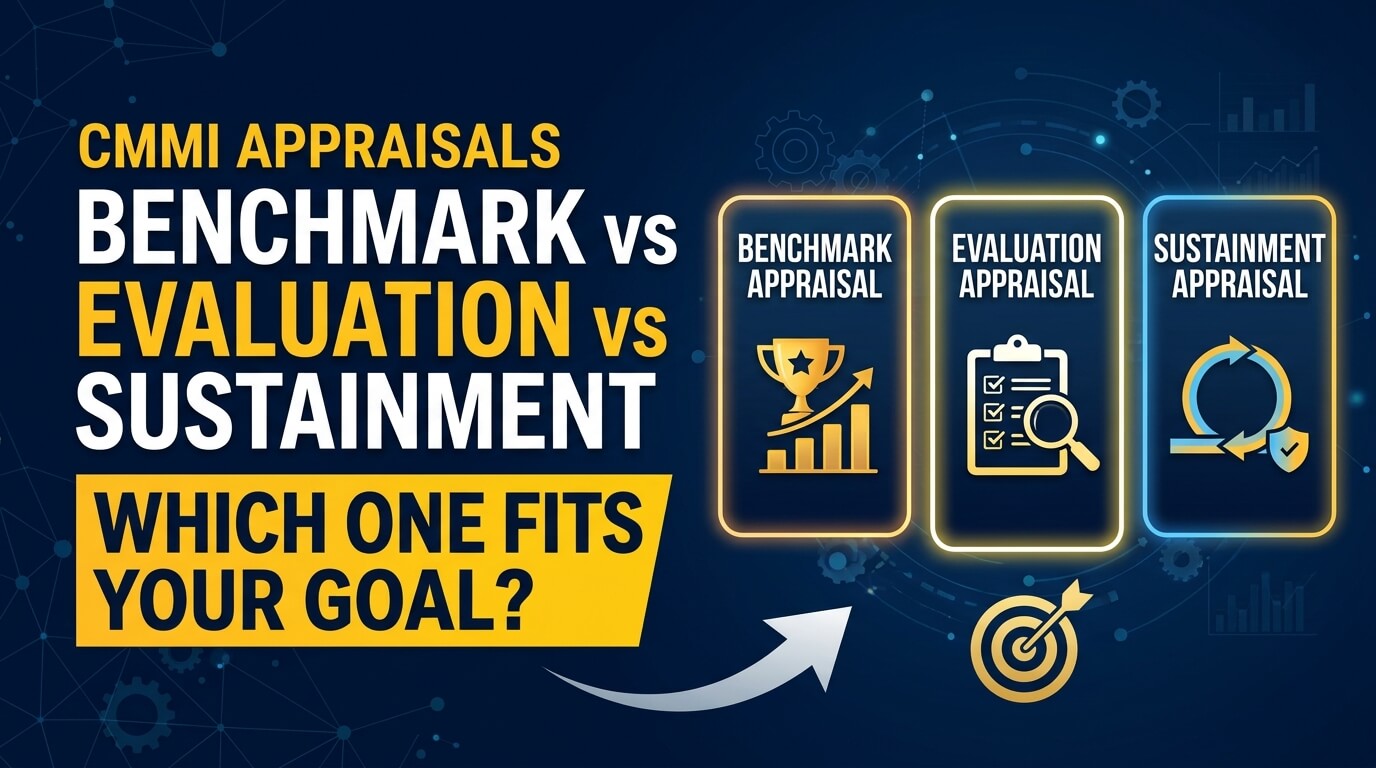
Organizations pursuing process improvement through the Capability Maturity Model Integration (CMMI) need to understand which appraisal approach aligns with their business objectives, improvement priorities, and stakeholder expectations. Choosing the right appraisal is essential because different appraisal types serve different purposes, have different requirements, and provide different forms of insight into organizational capability and maturity.
The topic CMMI Benchmark vs Evaluation vs Sustainment Appraisal is particularly important for organizations planning an initial appraisal, validating process improvement progress, maintaining previously established maturity, or demonstrating capabilities to customers and business partners.
Although these appraisal approaches are related, they are not equivalent and should not be treated as interchangeable. A Benchmark Appraisal, an Evaluation Appraisal, and a Sustainment Appraisal differ in purpose, scope, evidence requirements, and intended outcomes.
This guide provides a side-by-side comparison, practical scenarios, decision criteria, and a structured decision guide to help organizations determine which CMMI appraisal approach best fits their goals.
What Is a CMMI Appraisal?
A CMMI appraisal is a structured assessment of an organization's processes and practices against the applicable CMMI model requirements. It helps determine the extent to which organizational practices are implemented and institutionalized within the defined appraisal scope.
Depending on the appraisal type, the results may support organizational improvement, maturity-level or capability-level ratings, internal performance evaluation, or the continuation of previously established appraisal results.
CMMI appraisals are conducted according to the applicable CMMI appraisal method and requirements. The appraisal team evaluates objective evidence, examines process implementation, and assesses whether applicable practices are sufficiently demonstrated within the organizational unit and scope.
Organizations should distinguish between process improvement activities, internal evaluations, and formal CMMI appraisals. Completing a gap analysis or internal readiness assessment does not automatically mean that an organization has completed a formal CMMI appraisal.
CMMI Benchmark vs Evaluation vs Sustainment Appraisal: Key Differences
The most important distinction is the objective of the appraisal. Organizations seeking an initial formal maturity-level rating may require a Benchmark Appraisal, while those seeking improvement insight or continued recognition may consider other appraisal options, subject to applicable CMMI requirements.
Side-by-Side Comparison
| Comparison Criteria |
Benchmark Appraisal |
Evaluation Appraisal |
Sustainment Appraisal |
| Primary purpose |
Establish or formally benchmark organizational capability and maturity |
Evaluate process implementation and improvement progress |
Sustain an eligible existing appraisal result |
| Typical objective |
Obtain a formal benchmark result |
Understand strengths, weaknesses, and improvement opportunities |
Maintain continuity of an existing result |
| Formal maturity-level rating |
Yes, when applicable requirements are satisfied |
No formal maturity-level or capability-level rating |
May sustain an eligible prior result under defined conditions |
| Organizational improvement |
Supports improvement and benchmarking |
Strong focus on improvement insight |
Supports continued process discipline |
| Evidence requirements |
Comprehensive evidence for the defined scope |
Evidence appropriate to evaluation objectives and method |
Evidence demonstrating continued implementation and eligibility |
| Typical use |
Initial formal appraisal or new benchmark |
Readiness, improvement, or internal evaluation |
Eligible organizations maintaining existing appraisal results |
| Scope |
Defined organizational unit, model, domain, and appraisal scope |
Defined evaluation scope and objectives |
Subject to sustainment eligibility and applicable scope rules |
| Stakeholder value |
Formal result for eligible business and customer needs |
Diagnostic insight and improvement direction |
Continuity of a qualifying existing result |
| Key consideration |
Requires thorough preparation and appraisal planning |
Must not be confused with a Benchmark Appraisal |
Not a substitute for an initial Benchmark Appraisal |
Important: The precise rating, validity, eligibility, and reporting conditions depend on the applicable CMMI model version, appraisal method, and current requirements. Organizations should confirm these details with an authorized CMMI appraisal professional before making contractual or marketing claims.
1. CMMI Benchmark Appraisal: Establishing a Formal Result
A Benchmark Appraisal is designed to provide a formal assessment of organizational capability and maturity against the applicable CMMI model. It is commonly selected by organizations seeking a maturity-level or capability-level rating that can be communicated to customers, business partners, or other stakeholders.
When Should an Organization Choose a Benchmark Appraisal?
A Benchmark Appraisal may be appropriate when an organization:
- Is pursuing its first formal CMMI maturity-level appraisal.
- Wants to establish a recognized baseline for process capability.
- Needs to demonstrate process maturity to customers or business partners.
- Is responding to customer procurement or supplier qualification requirements.
- Has completed significant process improvement and is ready for formal appraisal.
- Wants to benchmark a defined organizational unit against the applicable CMMI model.
What Does Benchmark Appraisal Preparation Involve?
Preparation typically includes:
- Confirming the applicable CMMI model and domain.
- Defining the organizational unit and appraisal scope.
- Reviewing existing processes against applicable model practices.
- Conducting a structured gap analysis.
- Establishing process implementation and institutionalization.
- Identifying and organizing objective evidence.
- Preparing relevant personnel for interviews.
- Confirming appraisal logistics and team arrangements.
- Coordinating with the authorized appraisal professional.
A Benchmark Appraisal should not be approached as a documentation-only exercise. The objective is to demonstrate that relevant practices are implemented and supported by appropriate evidence within the defined scope.
2. CMMI Evaluation Appraisal: Understanding Improvement Opportunities
An Evaluation Appraisal focuses on understanding the organization's process implementation, identifying strengths and weaknesses, and supporting improvement decisions.
Organizations may use an evaluation to understand their current position before investing in a formal Benchmark Appraisal. It can also help evaluate progress after implementing process improvements.
When Should an Organization Choose an Evaluation Appraisal?
An Evaluation Appraisal may be appropriate when an organization:
- Wants to assess current process implementation before a formal appraisal.
- Needs to identify gaps against applicable CMMI practices.
- Is introducing a process improvement initiative.
- Wants to understand whether existing processes are consistently implemented.
- Needs practical improvement recommendations.
- Is uncertain about readiness for a formal maturity-level appraisal.
What Can an Evaluation Appraisal Help Identify?
An evaluation can provide insight into:
- Process implementation weaknesses.
- Inconsistent project or service management practices.
- Gaps in organizational process governance.
- Weaknesses in measurement and performance management.
- Inadequate evidence of process institutionalization.
- Improvement opportunities across relevant process areas.
- Risks that may affect future appraisal readiness.
An evaluation should be planned around clearly defined objectives. Organizations should confirm the exact evaluation method and intended outputs with the relevant CMMI professional because not every evaluation activity produces the same deliverables or formal results.
3. CMMI Sustainment Appraisal: Maintaining an Eligible Existing Result
A Sustainment Appraisal is intended for organizations that have already achieved an eligible formal appraisal result and want to sustain that result under the applicable CMMI requirements.
It is not intended to replace the initial Benchmark Appraisal. Eligibility depends on the organization's previous appraisal, current model and method requirements, and the conditions governing sustainment.
When Should an Organization Consider Sustainment?
A Sustainment Appraisal may be relevant when an organization:
- Has an existing eligible Benchmark Appraisal result.
- Wants to maintain continuity of its previously established result.
- Continues implementing and institutionalizing relevant processes.
- Has maintained appropriate process ownership and governance.
- Can demonstrate ongoing implementation within the eligible scope.
- Wants to avoid treating process improvement as a one-time initiative.
What Should Organizations Review Before Sustainment?
- Whether the previous appraisal result is eligible for sustainment.
- Applicable timing and scheduling requirements.
- Whether the model version and appraisal method permit the planned approach.
- Whether the organizational unit and scope remain eligible.
- Whether significant organizational changes affect the appraisal.
- Whether current evidence supports continued process implementation.
- Whether required appraisal participants and arrangements are in place.
Key point: Sustainment is not an automatic renewal. Organizations must verify eligibility and demonstrate that the applicable conditions have been satisfied.
Practical Scenarios: Which Appraisal Fits?
The following scenarios illustrate how organizations can select an appraisal approach based on their objectives.
Scenario 1: A Software Company Pursuing Its First CMMI Maturity Level
A software development company has introduced defined engineering, project management, quality assurance, measurement, and configuration management processes. Its management team wants to demonstrate organizational maturity to international customers.
Recommended direction: Benchmark Appraisal.
Why? The organization is pursuing an initial formal result and needs an appraisal designed to establish a benchmark within the defined organizational scope.
Scenario 2: An IT Service Provider Wants to Identify Process Gaps
An IT service provider has introduced incident management, service delivery, monitoring, and quality management processes. However, leadership is uncertain whether the practices are consistently implemented across teams.
Recommended direction: Evaluation Appraisal.
Why? The immediate objective is to understand current implementation and identify improvement opportunities before committing to a formal Benchmark Appraisal.
Scenario 3: An Organization Has an Existing Eligible Appraisal Result
A technology company previously completed a formal Benchmark Appraisal. It has maintained its process governance, measurement systems, and organizational practices and now wants to determine whether it qualifies to sustain its existing result.
Recommended direction: Sustainment assessment and appraisal planning.
Why? The organization already has a formal result and needs to confirm eligibility and continued implementation under the applicable sustainment requirements.
Scenario 4: A Company Has Improved Processes but Has Weak Evidence
A company has developed process documentation and trained its employees. However, it lacks consistent project records, performance data, and evidence showing that processes are applied in practice.
Recommended direction: Evaluation or internal readiness assessment before deciding on a Benchmark Appraisal.
Why? Document development alone does not demonstrate process implementation. An evaluation can help identify evidence and implementation gaps that need attention.
Scenario 5: A Business Unit Is Expanding Its Organizational Scope
An organization has a previous CMMI result but is expanding into additional teams, locations, or business functions. Management wants to know whether the existing result can cover the expanded operation.
Recommended direction: Scope review with an experienced CMMI appraisal professional.
Why? Organizational expansion may affect the appraisal scope, eligibility, and evidence requirements. Sustainment should not be assumed to cover new organizational units automatically.
Decision Guide: Choosing the Right CMMI Appraisal
Use the following decision points to identify the most appropriate starting point.
Decision Point 1: Do You Need a Formal Benchmark Result?
- Yes: Consider a Benchmark Appraisal and confirm the applicable model and scope.
- No: Proceed to the next decision point.
Decision Point 2: Is Your Primary Goal to Identify Process Gaps?
- Yes: Consider an Evaluation Appraisal or structured internal readiness assessment.
- No: Proceed to the next decision point.
Decision Point 3: Do You Already Have an Eligible Formal Appraisal Result?
- Yes: Explore Sustainment Appraisal eligibility.
- No: Sustainment is generally not the appropriate starting point; assess whether Benchmark or Evaluation better fits your objective.
Decision Point 4: Has Your Organizational Scope Changed?
- Yes: Confirm the impact of changes to teams, locations, services, projects, or organizational boundaries before selecting the appraisal.
- No: Proceed with validating your model, domain, and appraisal objectives.
Decision Point 5: Are Your Processes Implemented and Supported by Evidence?
- Yes: Discuss appraisal planning and readiness.
- No or uncertain: Begin with a gap analysis, improvement planning, or evaluation before committing to a formal Benchmark Appraisal.
Practical Example: Selecting an Appraisal for a Growing IT Company
Consider a hypothetical IT company with 150 employees across software development and IT services. The company has introduced organizational standards for project planning, quality assurance, risk management, service delivery, and performance measurement.
Management has three objectives:
- Improve consistency across development and service teams.
- Demonstrate process maturity to prospective enterprise customers.
- Maintain process discipline as the company expands.
These objectives may require different activities rather than a single appraisal.
| Business Objective |
Recommended Activity |
Reason |
| Identify process weaknesses |
Evaluation or gap analysis |
Establishes current strengths and improvement areas |
| Demonstrate formal maturity |
Benchmark Appraisal |
Establishes a formal result when applicable requirements are met |
| Maintain an existing eligible result |
Sustainment Appraisal |
Supports continuity under applicable requirements |
| Expand appraisal coverage |
Scope and eligibility review |
Determines how organizational changes affect appraisal planning |
The company should first confirm the applicable CMMI model and domain, determine its organizational-unit scope, and evaluate its readiness. It can then select the appropriate appraisal pathway based on business requirements and eligibility.
This staged approach can help reduce confusion, avoid premature appraisal commitments, and align process improvement investments with organizational goals.
CMMI Appraisal Role and Evidence Checklist
Effective appraisal planning requires coordination among leadership, process owners, practitioners, and the appraisal team. Responsibilities should be clarified before appraisal activities begin.
Roles and Responsibilities
| Role |
Practical Responsibility |
| Executive sponsor |
Approves objectives, resources, and organizational commitment |
| Appraisal coordinator |
Coordinates planning, communication, logistics, and evidence organization |
| Process owners |
Explain process design, implementation, and institutionalization |
| Project or service managers |
Provide relevant operational records and implementation examples |
| Practitioners |
Demonstrate how processes are applied in daily work |
| Measurement and quality personnel |
Explain metrics, analysis, reviews, and improvement activities |
| Lead Appraiser |
Provides appraisal leadership and confirms applicable method requirements |
| Appraisal team members |
Participate in appraisal activities according to their assigned responsibilities |
The exact roles, team composition, qualifications, and responsibilities depend on the applicable CMMI appraisal method and arrangements.
Evidence Checklist
Organizations should prepare relevant evidence based on the applicable model and appraisal scope.
- Organizational policies, standards, and process descriptions
- Process implementation records from relevant projects or services
- Project planning and monitoring records
- Risk identification, analysis, and management evidence
- Quality assurance and review records
- Measurement, metrics, and performance analysis
- Configuration and change management records
- Training, competency, and awareness records
- Supplier or subcontractor management evidence, where applicable
- Corrective actions and improvement records
- Evidence of management oversight and process governance
- Consistent examples from relevant organizational units
- Interview readiness for process owners and practitioners
Evidence should be authentic, traceable, relevant, and consistent with actual implementation. Organizations should not create artificial records merely to satisfy appraisal expectations.
Common Mistakes When Selecting a CMMI Appraisal
Organizations can improve planning by avoiding the following mistakes:
Treating All Appraisal Types as Equivalent
Benchmark, Evaluation, and Sustainment Appraisals have different objectives. Choosing based only on price or duration may lead to an unsuitable approach.
Assuming an Evaluation Automatically Produces a Maturity-Level Rating
An evaluation is not necessarily equivalent to a formal Benchmark Appraisal. Confirm the appraisal method, objectives, and expected outputs before making commitments.
Assuming Sustainment Is an Automatic Renewal
Sustainment depends on eligibility and applicable requirements. Organizations should confirm these conditions rather than assuming their previous result can simply be renewed.
Preparing Documentation Without Implementing Processes
Process documentation is useful, but it must reflect how work is performed. Evidence should demonstrate implementation, not merely the existence of written procedures.
Ignoring Organizational-Unit Scope
The appraisal scope influences which teams, projects, services, and organizational practices are evaluated. Expanding scope without proper planning may affect readiness and appraisal eligibility.
Making Unsupported Marketing Claims
Organizations should communicate CMMI results accurately. Claims about maturity levels, appraisal scope, model versions, and validity should be consistent with the official result and applicable requirements.
How to Prepare for a CMMI Appraisal
Regardless of the appraisal approach, preparation should begin with clear business objectives and a realistic understanding of the organization's current process maturity.
A practical preparation sequence includes:
- Define business objectives: Identify whether the goal is formal benchmarking, process evaluation, or sustainment.
- Confirm the applicable CMMI model: Identify the relevant model version and domain, such as Development, Services, or another applicable domain.
- Define organizational scope: Establish the organizational unit, teams, locations, projects, or services included.
- Conduct a gap analysis: Compare current practices with applicable model requirements.
- Develop an improvement plan: Prioritize gaps according to business risk, impact, and resources.
- Implement and institutionalize processes: Ensure processes are consistently used and understood.
- Collect and validate evidence: Review implementation records, performance data, and supporting documentation.
- Confirm appraisal arrangements: Discuss partner, Lead Appraiser, method, eligibility, scheduling, and expected outputs.
- Review readiness: Confirm whether the organization is prepared for the selected appraisal approach.
These activities should be tailored to the organization's actual needs rather than treated as a guaranteed or universally prescribed sequence.
Related CMMI Resources
Organizations exploring appraisal options may also benefit from reviewing related CMMI topics:
These resources can help organizations explore process improvement, appraisal preparation, IT process compliance, and related consulting support.
Authentic CMMI Resource for Further Research
For authoritative information about the CMMI model, appraisal approaches, and related guidance, consult the official CMMI Institute resource:
CMMI Institute — Official CMMI Resources
Organizations should use official model and appraisal guidance to confirm current requirements, terminology, eligibility, and applicable appraisal methods before making decisions.
Frequently Asked Questions
1. What is the difference between CMMI Benchmark, Evaluation, and Sustainment Appraisal?
A Benchmark Appraisal establishes a formal benchmark result, an Evaluation Appraisal helps assess process implementation and improvement opportunities, and a Sustainment Appraisal supports continuation of an eligible existing result under applicable requirements.
2. Which CMMI appraisal is best for a first-time organization?
A Benchmark Appraisal is generally the relevant option when the organization seeks its first formal maturity-level or capability-level result. An evaluation or readiness assessment may be useful beforehand.
3. Does a CMMI Evaluation Appraisal provide a formal maturity-level rating?
Not necessarily. The outcome depends on the specific appraisal method and objectives. Organizations should confirm whether a formal rating is expected before proceeding.
4. Can an organization choose Sustainment Appraisal without a previous Benchmark Appraisal?
Generally, Sustainment Appraisal is intended for eligible organizations with a qualifying existing appraisal result. Eligibility must be confirmed against current applicable requirements.
5. Is a Benchmark Appraisal suitable for both CMMI Development and Services?
CMMI appraisal planning depends on the applicable model and domain. Organizations should identify whether Development, Services, or another relevant domain fits their business activities and objectives.
6. How long does CMMI appraisal preparation take?
Preparation time varies according to organizational size, process maturity, appraisal scope, evidence availability, and improvement requirements. A readiness review can help establish a realistic timeline.
7. Can an organization expand its scope during Sustainment Appraisal?
Scope changes must be reviewed carefully. Additional teams, locations, projects, or services may affect eligibility and appraisal arrangements. Confirm scope requirements with the relevant appraisal professional.
8. Should an organization choose an appraisal based only on cost?
No. The appraisal should align with the organization's objectives, eligibility, scope, and expected outcome. Selecting an unsuitable appraisal may create unnecessary cost or fail to meet stakeholder requirements.
Conclusion
Selecting the right approach in CMMI Benchmark vs Evaluation vs Sustainment Appraisal begins with understanding the organization's objective.
A Benchmark Appraisal is generally appropriate when an organization seeks a formal benchmark result. An Evaluation Appraisal can help identify process strengths, weaknesses, and improvement opportunities. A Sustainment Appraisal may be appropriate when an organization has an eligible existing result and wants to sustain it under applicable requirements.
These appraisal approaches are not equivalent. Their purposes, requirements, scope, and expected outcomes must be understood before making a decision.
Organizations should begin by confirming their CMMI model and domain, defining their organizational-unit scope, reviewing process implementation, and discussing appraisal arrangements with qualified professionals.
Request a Scoped CMMI Consulting or Appraisal Discussion
B-ADVANCY supports organizations in exploring CMMI process improvement, appraisal readiness, and consulting requirements based on their business objectives.
Before proceeding, confirm:
- Model and domain: Which CMMI model and domain apply to your organization?
- Organizational-unit scope: Which teams, projects, services, or locations are included?
- Partner arrangements: Which authorized partner and appraisal arrangements are appropriate?
- Lead Appraiser arrangements: Who will lead the appraisal, and what requirements apply?
- Appraisal objective: Are you pursuing Benchmark, Evaluation, or eligible Sustainment?
Contact B-ADVANCY to discuss your requirements and identify a suitable, properly scoped approach to CMMI process improvement and appraisal planning.
📞 WhatsApp: Chat on WhatsApp 📧 Email:info@b-advancy.com


 Contact For Services
 Explore Training Calendar