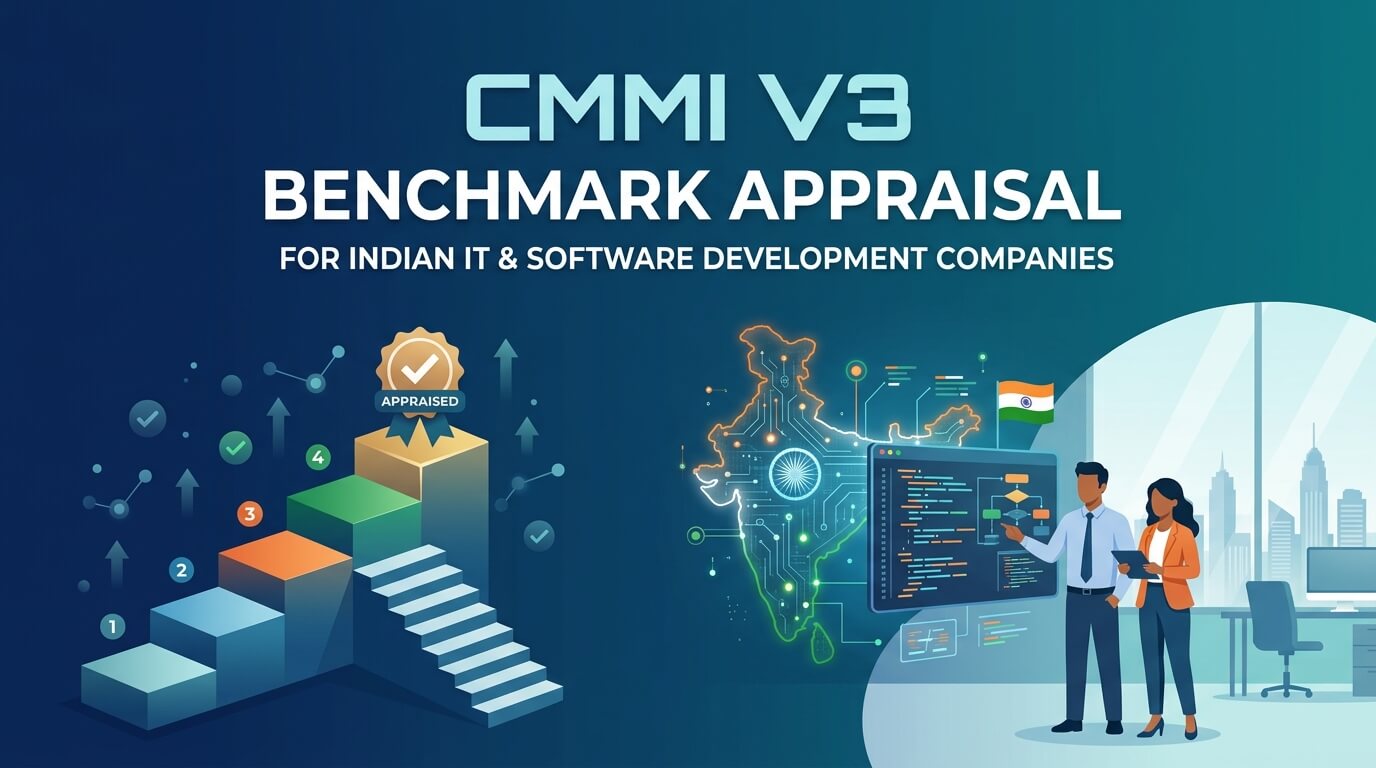
India's IT and software development industry serves clients across North America, Europe, Asia-Pacific, the Middle East, and other international markets. As customer expectations increase, software companies must demonstrate reliable delivery, consistent product quality, effective project management, and mature organizational processes. The CMMI V3.0 Benchmark Appraisal provides a structured way for eligible organizations to evaluate their processes against the Capability Maturity Model Integration (CMMI) framework and identify opportunities for measurable improvement.
For Indian IT service providers, software product companies, engineering teams, SaaS businesses, and technology consulting organizations, a CMMI Benchmark Appraisal can support process standardization, risk management, performance improvement, and customer confidence. It can also be relevant when enterprise customers or procurement teams specify CMMI appraisal requirements in supplier evaluations or contracts.
CMMI V3.0 offers an integrated framework for organizations seeking to improve how they develop products, deliver services, manage security-related practices, and achieve business objectives. However, an appraisal is not simply a documentation exercise. It requires evidence that relevant practices are implemented within the defined organizational scope.
This guide explains the CMMI V3.0 Benchmark Appraisal process, relevant considerations for Indian IT and software development companies, maturity levels, readiness activities, and how organizations can approach their improvement journey.
What Is a CMMI V3.0 Benchmark Appraisal?
CMMI, or Capability Maturity Model Integration, is a framework that helps organizations improve their processes, capabilities, and performance. It provides structured practices that organizations can use to establish consistent ways of working, manage operational risks, and align process improvement with business goals.
A CMMI Benchmark Appraisal is a formal appraisal conducted using the applicable CMMI appraisal method. It evaluates relevant organizational processes against the selected CMMI model and appraisal scope. The process identifies strengths and weaknesses and can result in a recognized maturity-level or capability-level achievement when the applicable requirements are satisfied.
CMMI V3.0 supports organizations with different business needs, work environments, and improvement objectives. An organization should select the relevant model areas and scope based on its actual activities, customer requirements, and intended outcomes rather than choosing a maturity target solely for marketing purposes.
For official information about appraisal types and requirements, visit the CMMI Institute Appraisals resource.
Why Indian IT and Software Development Companies Consider CMMI V3.0
Indian technology companies operate in a competitive market where clients may assess suppliers based on technical expertise, information security, service quality, delivery performance, risk controls, and organizational maturity. A well-planned CMMI improvement initiative can help organizations strengthen these capabilities and provide a clearer picture of how work is managed.
1. Meeting Customer and Contractual Expectations
Some enterprise customers, government-related projects, and international procurement processes may specify CMMI-related requirements for suppliers. An appropriate appraisal outcome can help an Indian IT company demonstrate that its processes have been independently evaluated against the applicable framework. Organizations should always confirm the exact level, model, scope, and appraisal conditions required by a prospective customer.
2. Standardizing Software Development Processes
Software companies may have multiple teams working with different project management methods, development tools, coding standards, and testing practices. A CMMI-oriented improvement program can help establish suitable organizational standards while allowing controlled tailoring for different projects. This approach supports consistency without requiring every project to operate in exactly the same way.
3. Improving Project Delivery and Product Quality
Structured planning, requirements management, verification, validation, risk management, and performance measurement can help teams identify problems earlier. Organizations can use defect trends, rework effort, estimation accuracy, and schedule performance to understand where their processes need improvement. The actual results depend on implementation quality and the organization's commitment to continuous improvement.
4. Strengthening Offshore and Distributed Delivery
Indian companies frequently coordinate development, testing, support, and implementation activities across multiple locations and time zones. Defined processes for communication, configuration management, project monitoring, and stakeholder engagement can reduce misunderstandings and improve coordination between distributed teams.
5. Supporting Sustainable Business Growth
As a company expands its workforce, service portfolio, customer base, or delivery locations, informal practices may become difficult to maintain. A structured process framework helps organizations identify responsibilities, retain organizational knowledge, monitor performance, and improve how work is delivered as operations grow.
CMMI V3.0 Model Areas Relevant to Indian Technology Companies
The appropriate CMMI model areas depend on an organization's services, products, risks, and business objectives. Indian technology companies should identify the areas that match their operational responsibilities and any customer or contractual requirements.
CMMI Development (DEV)
CMMI Development is relevant to organizations that develop software, digital products, systems, and other engineered solutions. It can support improvements in requirements development, technical solution design, product integration, verification, validation, planning, and project monitoring, depending on the applicable model and scope.
Indian software product companies, custom application developers, fintech engineering teams, enterprise software vendors, and digital transformation providers may consider this area when their primary objective is to improve product development and engineering processes.
CMMI Services (SVC)
CMMI Services is relevant to organizations that deliver and manage services for customers. Depending on the business context, this may include IT operations, managed services, application support, technical support, service delivery, and other ongoing service activities.
For Indian IT service providers, a structured approach to service delivery can support service planning, work monitoring, incident handling, quality management, stakeholder communication, and performance improvement where these activities fall within the applicable model and scope.
CMMI Security (SEC)
Security-related practices can be important for organizations handling confidential customer data, financial information, intellectual property, cloud environments, and sensitive software systems. Companies should evaluate the relevance of CMMI Security against their security objectives and risk profile, rather than assuming that a CMMI appraisal replaces a dedicated security assessment or certification.
CMMI model selection should be based on the current official model documentation and the organization's intended appraisal scope. Not every organization needs every model area, and model-area selection should be confirmed with a qualified CMMI professional when necessary.
Understanding CMMI Maturity Levels
CMMI maturity levels describe an organization's process improvement progression across a defined set of practices and model requirements. The appropriate target depends on the organization's current capabilities, business priorities, customer requirements, and readiness. A higher target generally involves more demanding expectations for institutionalized practices and performance management.
Maturity Level 1 – Initial
At this level, work may be completed, but outcomes can be unpredictable. Processes may depend heavily on individual effort, and project results can vary significantly when priorities, resources, or requirements change.
Maturity Level 2 – Managed
Processes are planned, performed, monitored, and controlled at the project or work level. Teams establish responsibilities, manage commitments, and maintain relevant work records to support consistent execution.
Maturity Level 3 – Defined
Organization-wide standards and defined processes guide work across projects, with appropriate tailoring for specific needs. Organizational assets and lessons learned help teams adopt more consistent practices and support improvement across the business.
Maturity Level 4 – Quantitatively Managed
Quantitative management emphasizes the use of measurement and analysis to manage performance. Organizations establish relevant performance objectives, analyze process variation, and use data to support more predictable outcomes.
Maturity Level 5 – Optimizing
The focus is on continuous improvement, addressing root causes, and improving the organization's ability to respond to change. Organizations use performance information and systematic improvement approaches to strengthen their processes over time.
CMMI V3.0 Benchmark Appraisal Process for Indian IT Companies
Preparing for a Benchmark Appraisal requires coordinated effort from management, process owners, project teams, and other relevant stakeholders. The exact appraisal activities and requirements depend on the selected model, scope, and applicable appraisal method.
Step 1: Define the Business Objective and Appraisal Scope
Start by identifying why the organization wants a CMMI appraisal. Objectives may include meeting a customer requirement, improving development processes, strengthening service delivery, or establishing more consistent performance management. Define the organizational units, work types, locations, and other scope boundaries that need to be considered under the applicable appraisal rules.
Step 2: Conduct a Readiness and Gap Assessment
Review current processes against the applicable CMMI model requirements. Identify missing practices, inconsistent implementation, insufficient records, unclear responsibilities, and areas where teams rely on informal methods. A readiness assessment helps management prioritize improvement work before proceeding with a formal appraisal.
Step 3: Establish and Improve Organizational Processes
Develop or improve process descriptions, work instructions, templates, governance arrangements, and supporting tools as needed. Processes should reflect how work is intended to be performed while allowing suitable tailoring. Documentation should support actual implementation rather than exist only to satisfy an appraisal checklist.
Step 4: Implement Processes Across the Defined Scope
Ensure that the relevant teams understand their responsibilities and apply the established processes to real work. Management should monitor adoption, address implementation barriers, and ensure that process owners and project teams understand how their activities support organizational objectives.
Step 5: Collect and Review Objective Evidence
Maintain appropriate evidence of process implementation. Depending on the applicable practices and scope, evidence may include project plans, requirements records, review results, test reports, defect logs, risk registers, change records, performance measurements, and management review outputs. Evidence should be genuine, traceable, relevant, and consistent with actual work performed.
Step 6: Address Gaps and Confirm Readiness
Review unresolved gaps, assign corrective actions, and verify whether the changes have been implemented effectively. Conducting internal reviews and readiness checks can help teams identify weaknesses before formal appraisal activities. Avoid making unsupported claims that a particular result is guaranteed.
Step 7: Arrange the Formal Benchmark Appraisal
Work with an appropriately qualified and authorized CMMI Lead Appraiser and follow the applicable CMMI appraisal requirements. The formal appraisal evaluates the defined scope and evidence according to the relevant method. The outcome depends on the appraisal findings and whether the required criteria are satisfied.
Important Evidence for Software Development Organizations
Evidence should demonstrate that the relevant processes are implemented in practice. The exact evidence required varies with the selected model, maturity target, appraisal scope, and applicable rules. Indian IT and software development companies may need to review the following categories when preparing their processes and records:
- Project planning and monitoring: Plans, schedules, estimates, resource allocations, status reports, and records of corrective action.
- Requirements management: Requirements baselines, traceability records, stakeholder reviews, and change-control evidence.
- Engineering and development: Design records, technical reviews, code review evidence, integration records, and relevant engineering work products.
- Verification and validation: Test strategies, test cases, test execution records, defect reports, and acceptance evidence.
- Risk and issue management: Risk registers, mitigation plans, issue tracking, escalation records, and follow-up actions.
- Configuration and change management: Version-control practices, release records, approved changes, and configuration status information.
- Measurement and performance: Defined metrics, reliable data, analysis results, performance reviews, and improvement actions where applicable.
- Process governance: Defined responsibilities, training records, process reviews, and evidence of organizational implementation.
These categories are practical preparation examples, not a universal checklist that guarantees a successful appraisal. Companies should confirm their specific evidence requirements with a qualified CMMI professional who understands the applicable model and scope.
How CMMI V3.0 Can Support Different Indian Technology Businesses
Software Product Development Companies
Software product companies can use structured processes to improve requirements definition, design reviews, testing, release planning, defect management, and product maintenance. Consistent practices can help teams manage product complexity and maintain quality as their products evolve.
IT Outsourcing and Offshore Development Providers
Outsourcing companies may need to coordinate multiple client projects, delivery teams, and contractual commitments. Defined planning, monitoring, communication, and quality-control processes can help strengthen consistency across customer engagements and provide clearer visibility into project performance.
SaaS and Cloud-Based Technology Companies
SaaS providers can examine their software development, release management, service operations, customer support, and risk management processes. CMMI-related improvement can complement other security and service management initiatives, but it should not be presented as a substitute for specific cloud security or regulatory requirements.
IT Consulting and Digital Transformation Companies
Consulting and digital transformation organizations may manage complex projects involving business analysis, system integration, software customization, and stakeholder coordination. Defined processes can help them control changes, manage delivery risks, maintain project visibility, and improve consistency across engagements.
CMMI V3.0 Benchmark Appraisal vs. ISO Certification
Indian IT companies may also operate management systems aligned with standards such as ISO 9001 for quality management or ISO/IEC 27001 for information security management. Although these initiatives may support some overlapping business objectives, CMMI appraisals and ISO certification are not interchangeable.
A CMMI Benchmark Appraisal evaluates organizational processes against the applicable CMMI model and appraisal method. ISO certification, by contrast, involves an applicable management system standard and a certification process conducted under the relevant certification arrangements. Each has its own criteria, scope, and intended outcomes.
Organizations should identify the specific requirement stated by their customers or tender documents before selecting an improvement or assessment route. Holding an ISO certificate does not automatically establish a CMMI maturity level, and a CMMI appraisal outcome does not automatically establish ISO certification.
Choosing CMMI Appraisal Support in India
Selecting appropriate support is an important part of an organization's CMMI journey. Companies should evaluate the proposed services, the provider's experience, the selected model and scope, and the qualifications of professionals involved. Clear role separation is also important because process consulting and readiness support are different from conducting a formal appraisal.
Before proceeding, Indian IT and software development companies should consider the following:
- Confirm that the proposed CMMI model and maturity target match the business requirement.
- Define the organizational units, projects, work types, and locations within the intended scope.
- Check the qualifications and current authorization of the professional responsible for a formal appraisal.
- Clarify the difference between consulting, training, readiness assessments, and formal appraisal services.
- Agree on the responsibilities, schedule, deliverables, and expected evidence before starting the engagement.
- Verify published appraisal results independently when evaluating a provider's or organization's claimed achievement.
How B-ADVANCY Can Help Organizations Explore Process Improvement
B-ADVANCY supports organizations seeking to strengthen business assurance, management system practices, IT process compliance, and organizational performance. Indian IT and software development companies exploring CMMI-related improvement can begin by identifying their business objectives, reviewing current processes, and determining the scope of support required.
Depending on an organization's needs, useful preparation activities may include process gap identification, review of existing documentation, improvement planning, performance measurement, and readiness coordination. These activities can help management understand current process weaknesses and determine practical next steps toward the intended objectives.
Any formal CMMI Benchmark Appraisal must follow the applicable CMMI appraisal requirements and be conducted by appropriately qualified and authorized professionals. Organizations should confirm the provider's role and authorization before engaging a service and should not rely on a guaranteed maturity-level promise.
To discuss IT process compliance and organizational improvement requirements, visit B-ADVANCY IT Process Compliance or explore the B-ADVANCY website for further information about available services.
Frequently Asked Questions (FAQs)
What is a CMMI V3.0 Benchmark Appraisal?
A CMMI V3.0 Benchmark Appraisal is a formal evaluation of an organization's processes against the applicable CMMI model and appraisal method. It identifies process strengths and weaknesses and may result in a recognized maturity-level or capability-level achievement when the applicable criteria are satisfied.
Why should Indian software companies consider a CMMI appraisal?
Indian software companies may consider a CMMI appraisal to support process standardization, improve project management, strengthen quality practices, evaluate organizational capabilities, and address customer or contractual requirements. The value depends on the company's objectives and how effectively it applies process improvements.
Which CMMI maturity level should an Indian IT company target?
The appropriate target depends on the company's existing process maturity, business priorities, customer requirements, and improvement goals. Organizations should conduct a readiness assessment and confirm the applicable scope before deciding on a target maturity level.
How long does CMMI V3.0 appraisal preparation take?
Preparation time varies according to organizational size, scope, current process implementation, evidence quality, management commitment, and the targeted level. Companies with established processes may need less improvement work than organizations building consistent practices for the first time. A readiness assessment can help establish a realistic plan.
Is CMMI V3.0 a certification?
CMMI is generally described in terms of appraisals and maturity-level or capability-level achievements, rather than ISO-style management system certification. Organizations should use accurate terminology in marketing materials, contracts, and customer communications and confirm the exact appraisal outcome through the appropriate official sources.
Can a company use CMMI V3.0 with Agile and DevOps practices?
Organizations can evaluate how their Agile, DevOps, and continuous delivery practices align with applicable CMMI expectations. The objective is to establish effective, evidence-based processes that support business performance rather than introduce unnecessary documentation. The exact implementation should reflect the selected model, scope, and organizational context.
Where can organizations verify published CMMI appraisal results?
Organizations can consult the official CMMI Published Appraisal Results System (PARS) at official website. The system provides published Benchmark and Sustainment appraisal results subject to applicable publication arrangements.
Conclusion
The CMMI V3.0 Benchmark Appraisal can be an important step for Indian IT and software development companies seeking to strengthen their processes, demonstrate organizational capabilities, and improve business performance. By defining clear objectives, selecting the appropriate model and scope, implementing effective practices, and maintaining reliable evidence, organizations can prepare for a more structured appraisal journey.
The greatest value comes from using CMMI as a framework for continuous improvement rather than treating the appraisal as a documentation exercise. Software companies should focus on practical outcomes such as more consistent delivery, stronger requirements management, improved quality, effective risk controls, and measurable process performance. A well-planned approach can help organizations align their operational capabilities with customer expectations and long-term business goals.
Indian technology companies interested in process improvement and IT compliance support can Contact B-ADVANCY to discuss their requirements and identify suitable next steps.
📞 WhatsApp:Chat on WhatsApp📧 Email:info@b-advancy.com


 Contact For Services
 Explore Training Calendar