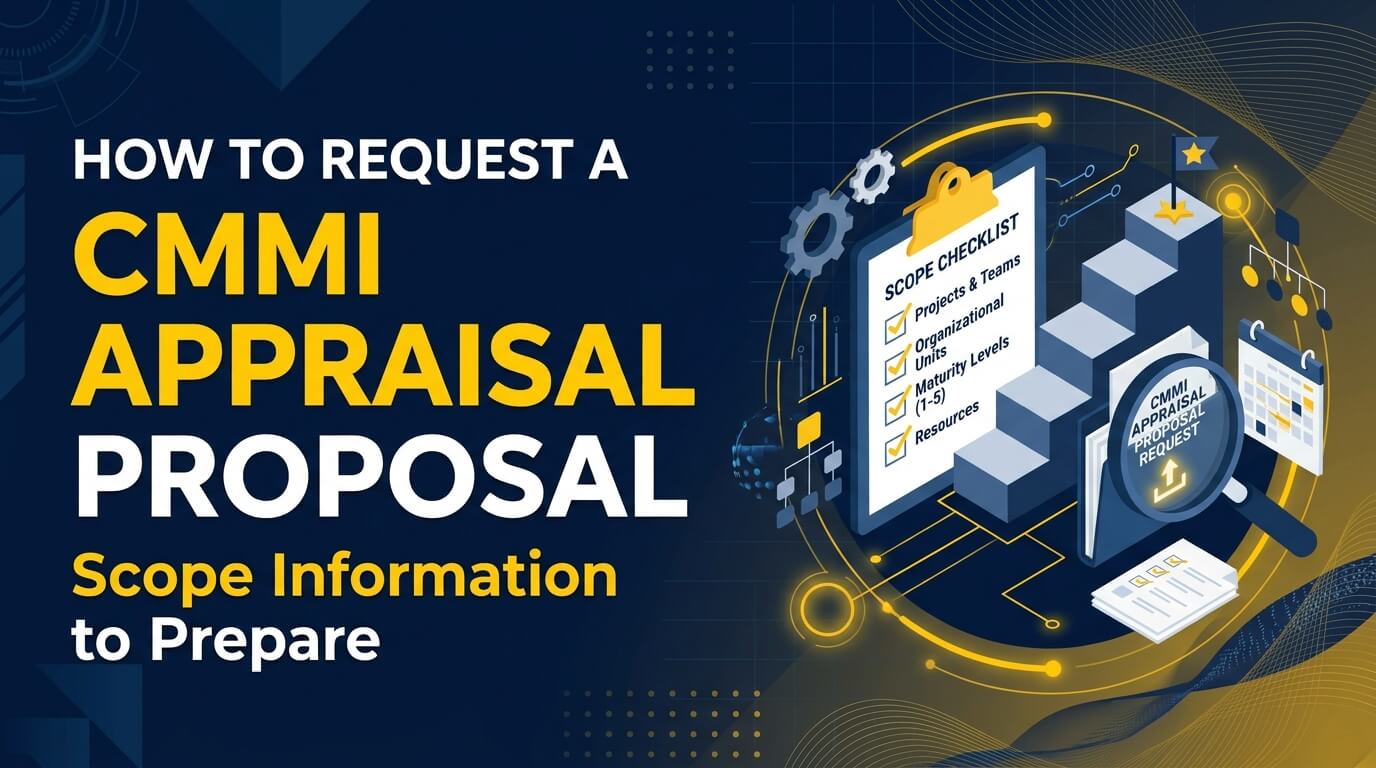
Requesting a Capability Maturity Model Integration (CMMI) appraisal proposal is an important step for organizations seeking to evaluate their processes, demonstrate process capability, or establish a structured improvement programme. However, a proposal can only be accurate when the organization provides sufficient information about its objectives, organizational boundaries, business activities, selected CMMI model, expected appraisal type, and current readiness.
Organizations that approach providers with only a target maturity level and a preferred completion date may receive estimates that are incomplete, difficult to compare, or based on assumptions that later affect cost and scheduling. A well-prepared request helps the provider understand the actual appraisal requirements and develop a proposal with clearly defined scope, responsibilities, deliverables, dependencies, and exclusions.
This guide explains how to request a CMMI appraisal proposal, what scope information to prepare, which evidence and documents may be useful during initial discussions, and how to evaluate a provider's response. It is intended for business leaders, quality managers, process improvement teams, project managers, IT service providers, and organizations planning a formal CMMI appraisal.
1. Why Preparing Scope Information Matters Before Requesting a Proposal
A CMMI appraisal is not simply a review of policies, procedures, or documentation. It is an evidence-based evaluation of how processes are implemented within a defined organizational context. The appraisal method considers the selected model scope, organizational unit, process implementation, participants, and other applicable requirements.
Consequently, two organizations requesting an appraisal at the same maturity level may require substantially different appraisal arrangements. Their business domains, number of projects, organizational structures, operating locations, process coverage, and evidence availability may differ considerably.
Preparing scope information before contacting a provider helps to:
- Clarify the business purpose and expected value of the appraisal.
- Identify the appropriate CMMI model, domain, and appraisal type.
- Define the organizational unit and boundaries under consideration.
- Estimate the required appraisal resources and schedule.
- Identify readiness gaps, evidence limitations, and potential dependencies.
- Compare proposals using consistent scope and deliverable requirements.
- Reduce misunderstandings about responsibilities, exclusions, and commercial assumptions.
The objective is not to prepare every appraisal document before requesting a proposal. It is to provide enough reliable information for a qualified provider to understand the organization and explain what would be required to proceed.
2. Define the Business Objective and Reason for the Appraisal
Start by explaining why the organization is considering a CMMI appraisal. The reason can influence the appraisal type, scope, expected outputs, management involvement, and project priorities.
Common business objectives include:
- Process improvement: Identify strengths, weaknesses, and opportunities to improve organizational performance.
- Customer requirements: Respond to contractual, supplier qualification, or customer expectations.
- Market positioning: Demonstrate relevant appraisal results to customers and business partners.
- Organizational consistency: Improve the consistency of processes across projects, teams, departments, or service operations.
- Performance management: Establish a structured approach to monitoring process implementation and business performance.
The organization should also explain whether it is seeking an initial appraisal, a follow-on appraisal, an appraisal for internal improvement, or a formal Benchmark Appraisal. These objectives should not be treated as interchangeable because different appraisal types have different purposes and requirements.
Questions to prepare
- What business problem should the appraisal help address?
- Is the primary objective internal improvement, customer confidence, or a formal Benchmark Appraisal?
- Is there a customer or contractual deadline?
- What organizational performance improvements are expected?
- Who will sponsor and fund the appraisal?
A clear business objective helps a provider recommend an appropriate approach rather than preparing a quotation based on an assumed appraisal requirement.
3. Identify the CMMI Model, Domain, and Target Level
The next step is to identify the CMMI model and domain relevant to the organization's activities. CMMI is used across different business contexts, so the selected model scope should reflect the work performed by the organizational unit being considered.
Depending on the organization's objectives and operating environment, the discussion may involve domains such as Development, Services, Security, Supplier Management, or other applicable areas within the current CMMI product suite. The exact model and domain terminology, version, and available appraisal options should be confirmed against the current official requirements.
The organization should communicate its intended maturity or capability objective. For example, it may be considering a Maturity Level 3 or Maturity Level 5 target. However, a target level is not a guaranteed appraisal result. The appraisal team determines ratings based on the applicable method requirements and the objective evidence available within the approved scope.
Model and target information to include
- Preferred CMMI model and domain.
- Current model version or any version specified by the customer.
- Intended maturity level or capability level objective.
- Whether one or multiple domains are being considered.
- Any existing CMMI appraisal history or previous assessment findings.
- Any customer-specific or contractual requirements affecting the model scope.
Practical consideration: If the organization is unsure which domain or appraisal option is appropriate, it should explain its business activities and objectives instead of selecting a model solely because another company uses it. A qualified provider can help clarify the options during discovery.
4. Define the Organizational Unit and Appraisal Boundaries
One of the most important parts of a CMMI appraisal proposal is the organizational scope. The organizational unit is the defined part of the organization whose processes are being considered. It may include selected departments, projects, teams, functions, locations, or service operations, depending on the applicable appraisal requirements and the way work is organized.
An organization should not assume that including its company name automatically means every department, project, subsidiary, or location is covered. The boundaries must be described transparently so the provider can understand what is included and what remains outside the proposed scope.
Organizational information to prepare
- Legal entity and business unit name.
- Departments, teams, and functional groups proposed for inclusion.
- Number of employees and relevant process participants.
- Number and type of projects, products, or services.
- Operating locations and distributed or remote teams.
- Organizational support functions and their responsibilities.
- Functions, projects, or locations proposed for exclusion, with reasons.
For example, a software organization may want to include its software development teams, project management function, quality assurance function, and configuration management support. If the organization also operates a separate customer support service, it should clarify whether that service belongs within the proposed organizational unit or is outside the current scope.
The provider should explain how the proposed organizational boundaries, sampling approach, support functions, and process coverage will be confirmed under the applicable appraisal method. The final scope must be established through the required appraisal planning activities, not simply assumed from an initial sales discussion.
5. Prepare a Summary of Current Process Implementation and Readiness
A provider needs to understand how the organization currently performs its work. The existence of documented procedures is useful, but documentation alone does not establish that a process is implemented consistently or supported by sufficient objective evidence.
Before requesting a proposal, prepare a brief overview of the organization's process environment. Include information about how work is planned, performed, monitored, reviewed, controlled, and improved. Identify whether processes are standardized across the organizational unit or vary between projects and teams.
Examples of useful evidence and artifacts
| Evidence category |
Example artifacts |
What it helps clarify |
| Process governance |
Process descriptions, policies, procedures, process ownership records |
How processes are defined and governed |
| Project management |
Project plans, schedules, status reports, risk registers |
How projects are planned and monitored |
| Requirements management |
Requirements specifications, traceability records, change requests |
How requirements and changes are controlled |
| Quality assurance |
Review records, audit reports, nonconformity logs, corrective actions |
How process and product quality are evaluated |
| Configuration management |
Version histories, baselines, repository records, change approvals |
How work products and changes are controlled |
| Measurement and analysis |
Metrics definitions, dashboards, analysis reports, measurement plans |
How performance data is collected and used |
| Training and competency |
Training plans, attendance records, competency assessments |
How people are prepared for their process responsibilities |
| Risk management |
Risk registers, mitigation plans, issue logs, review records |
How organizational and project risks are addressed |
These are illustrative examples, not a universal mandatory document list. The required evidence depends on the selected CMMI model, version, practices in scope, organizational context, and applicable appraisal method. A provider should avoid suggesting that simply producing a fixed set of documents guarantees a particular appraisal rating.
6. Establish the Appraisal Type, Schedule, and Delivery Expectations
CMMI appraisal types serve different purposes. The organization should explain what it expects to achieve so the provider can discuss the appropriate option.
| Appraisal type |
General purpose |
Discussion point |
| Benchmark Appraisal |
Formal appraisal that can produce applicable benchmark ratings. |
Confirm model scope, organizational scope, eligibility, method, and expected outputs. |
| Sustainment Appraisal |
Evaluates whether an organization is maintaining its previously appraised level. |
Confirm the prior appraisal details and applicable sustainment requirements. |
| Evaluation Appraisal |
A flexible appraisal option that can help identify improvement opportunities and support preparation. |
Clarify its purpose and how its outputs differ from a Benchmark Appraisal. |
| Action Plan Reappraisal |
A follow-up option for eligible organizations that did not achieve the intended result in a prior appraisal. |
Confirm eligibility, timing, and current method requirements. |
The organization should also communicate its preferred start date, target completion window, blackout periods, operational constraints, and availability of key participants. If a customer deadline exists, provide the date and explain whether it is contractual, commercial, or an internal target.
Avoid asking a provider to guarantee an appraisal result by a fixed date. The schedule depends on readiness, scope confirmation, participant availability, evidence coverage, appraisal planning, and applicable method requirements.
7. What Information Should a CMMI Appraisal Proposal Include?
A professional proposal should make it possible for the organization to understand exactly what is being offered, what assumptions have been made, what the organization must provide, and what is excluded. Do not evaluate proposals based on price alone.
The following items provide a practical basis for reviewing a proposal:
| Proposal component |
What to look for |
| Understanding of objectives |
A clear summary of the organization's business objectives and appraisal expectations. |
| Model and domain scope |
The proposed model, version, domain, representation where applicable, and target level. |
| Organizational scope |
The organizational unit, participating groups, locations, projects, and relevant support functions. |
| Method and appraisal type |
The proposed appraisal type and applicable method, including relevant requirements and assumptions. |
| Delivery approach |
Key activities, phases, proposed duration, location or remote arrangements, and milestones. |
| Team and qualifications |
The proposed Lead Appraiser and team arrangements, relevant qualifications, and responsibilities. |
| Deliverables |
The reports, findings, records, ratings where applicable, and other outputs included in the engagement. |
| Responsibilities |
The respective responsibilities of the provider, appraisal team, sponsor, and organizational participants. |
| Commercial terms |
Fees, taxes, travel, accommodation, payment milestones, cancellation terms, and additional costs. |
| Assumptions and exclusions |
Dependencies, scope limitations, excluded services, and conditions that may change the estimate. |
The proposal should distinguish appraisal services from optional consulting, training, readiness reviews, or process improvement support. If these activities are offered together, the responsibilities and boundaries should be transparent, including any applicable independence or conflict-of-interest considerations.
8. How to Evaluate a CMMI Appraisal Provider
Selecting a provider requires more than comparing quotations. Organizations should verify that the proposed appraisal arrangements are appropriate for the intended scope and that the relevant professionals meet current programme requirements.
Provider evaluation criteria
- Official programme status: Verify the relevant partner and Lead Appraiser information through current official CMMI/ISACA resources. Do not rely only on a provider's marketing statements.
- Lead Appraiser qualifications: Confirm the proposed Lead Appraiser's current status, relevant experience, and ability to lead the intended appraisal.
- Relevant domain experience: Ask about experience with organizations operating in a similar business domain, such as software development, IT services, security, or supplier management.
- Scope understanding: Assess whether the provider asks detailed questions about the organizational unit, project structure, support functions, and process coverage.
- Method knowledge: Confirm that the proposed approach follows the current applicable CMMI Appraisal Method Definition Document (MDD) and related policies.
- Transparent deliverables: Check whether outputs, reporting arrangements, responsibilities, and exclusions are clearly stated.
- Confidentiality and data handling: Discuss access to organizational records, information security, confidentiality, and retention arrangements.
- Commercial transparency: Request a breakdown of professional fees, travel expenses, taxes, optional services, and potential additional charges.
Ask providers to explain how they will confirm the appraisal scope and identify readiness dependencies. Be cautious of proposals that promise a guaranteed maturity level, offer an appraisal without meaningful evidence review, or cannot identify the proposed Lead Appraiser and applicable appraisal arrangements.
9. Expected Deliverables and Engagement Dependencies
Deliverables vary according to the engagement type and applicable appraisal method. A proposal should identify which outputs are included in the agreed service and which activities are separate or optional.
Potential deliverables and outputs may include:
- An agreed scope description and appraisal planning information.
- A schedule of preparation and appraisal activities.
- Participant preparation and coordination arrangements.
- Appraisal findings identifying relevant strengths and weaknesses.
- Ratings and results where the selected appraisal type and method provide for them.
- Applicable appraisal records and reporting outputs.
- Post-appraisal feedback or follow-up arrangements, where included.
For a formal appraisal, confirm how required records and outputs will be handled under the applicable programme requirements. For example, the Appraisal Disclosure Statement (ADS) is an important summary of appraisal ratings and the conditions and constraints under which the appraisal was performed. It should not be confused with a general consultancy report.
Dependencies to discuss before approval
- Management approval and an identified appraisal sponsor.
- Availability of project teams, process owners, and relevant support functions.
- Access to representative work products and process implementation evidence.
- Agreement on the organizational unit and model scope.
- Availability of relevant locations, systems, records, and participants.
- Completion of agreed readiness or improvement activities before formal appraisal activities begin.
- Compliance with current appraisal registration, planning, and programme policies.
A proposal should state how changes to these dependencies may affect the schedule, resources, or commercial terms. This makes it easier to manage expectations and avoid disputes after the engagement begins.
10. Practical Example: Preparing a Proposal Request for a Software Company
Consider a software development company that wants to explore a CMMI Benchmark Appraisal. The company has multiple development teams, a quality assurance function, a project management office, and a configuration management function. Management is considering a Maturity Level 3 objective because of customer expectations and its internal process improvement strategy.
Instead of sending a short email stating only, "We need CMMI Level 3 appraisal pricing," the company prepares a structured request containing the following information:
| Information |
Illustrative response |
| Business objective |
Improve development process consistency and address customer expectations. |
| Model and domain |
CMMI Development domain, subject to confirmation against current model requirements. |
| Target objective |
Explore a Maturity Level 3 Benchmark Appraisal. |
| Organizational unit |
Selected software development business unit and associated support functions. |
| Projects and teams |
Multiple active development projects and their relevant teams. |
| Existing processes |
Documented project management, requirements, quality assurance, and configuration management processes. |
| Evidence availability |
Project plans, requirements records, review reports, metrics, risk registers, and change histories. |
| Preferred timing |
A proposed appraisal window after an initial readiness review and scope confirmation. |
| Requested support |
A scoped proposal covering appraisal arrangements, responsibilities, deliverables, schedule, and fees. |
This information gives the provider a more useful starting point. It can identify the questions that still require clarification, assess the proposed scope, explain the relevant appraisal arrangements, and prepare a quotation based on stated assumptions. It does not establish that the company is ready or that it will achieve the intended maturity level. Those matters require appropriate preparation and evaluation under the applicable method.
11. Common Mistakes to Avoid When Requesting a CMMI Appraisal Proposal
Incomplete requests can create unrealistic expectations and make proposals difficult to compare. The following mistakes are particularly important to avoid:
- Requesting a price without defining scope: A quotation based only on the desired maturity level may omit important organizational and model-scope considerations.
- Assuming the entire company is included: The organizational unit and its boundaries must be identified and confirmed.
- Confusing consulting with appraisal: Process improvement support and formal appraisal activities are different services and should be described separately.
- Focusing only on documentation: Written procedures should be supported by evidence of actual process implementation.
- Ignoring project and participant coverage: The organization should discuss its operating structure and the people who perform relevant process roles.
- Choosing a provider based only on price: Qualifications, programme status, method knowledge, scope clarity, and deliverables matter.
- Accepting guaranteed appraisal results: No provider should promise a particular rating as a commercial certainty. Ratings depend on the applicable method and appraisal evidence.
- Overlooking additional costs: Travel, accommodation, taxes, extra preparation, and changes in scope should be clarified before signing.
- Using outdated requirements: Model versions, appraisal methods, and programme policies can change. Confirm the current applicable requirements before finalizing the engagement.
12. How to Validate the Proposal Before Accepting It
Before signing an agreement, conduct a structured review of the proposal. The goal is to confirm that the proposed service matches the organization's objectives and that all important scope assumptions are visible.
Use the following validation checklist:
- The business objective and reason for the appraisal are accurately stated.
- The proposed CMMI model, domain, version, and target objective are identified.
- The appraisal type is appropriate for the intended outcome.
- The organizational unit and proposed boundaries are described.
- Relevant projects, teams, functions, and locations have been considered.
- The proposed Lead Appraiser and relevant programme status can be verified through official resources.
- The applicable appraisal method and policy requirements have been considered.
- Deliverables, reporting arrangements, and exclusions are clear.
- Responsibilities and dependencies are assigned to the appropriate parties.
- The schedule, fees, payment terms, and additional costs are transparent.
- There are no unsupported promises of guaranteed ratings or outcomes.
For independent validation, review the current official CMMI appraisal information, appraisal types, programme policies, and relevant Lead Appraiser or Partner directory information. Where the proposal refers to a particular model version or policy, ask the provider to identify the applicable official reference. This helps ensure that the proposed engagement is based on current requirements rather than outdated assumptions.
13. Request a Scoped CMMI Discovery Discussion with B-ADVANCY
Preparing a CMMI appraisal request can involve several connected decisions, including model and domain selection, organizational boundaries, target objectives, readiness, evidence availability, delivery expectations, and appraisal arrangements. Discussing these elements before requesting a final proposal can help an organization identify missing information and establish a more realistic engagement scope.
B-ADVANCY Certification UK Limited supports organizations seeking to understand certification, assessment, audit, consulting, and professional development requirements across different business and management system contexts. For organizations exploring CMMI-related support, an initial scoped discussion can help clarify the objectives, boundaries, expected deliverables, readiness considerations, and next steps required for a properly defined engagement.
A discovery discussion can cover:
- Your business objectives and reasons for considering a CMMI appraisal.
- The relevant CMMI model, domain, version, and target objective.
- The proposed organizational unit, projects, functions, and locations.
- Existing process implementation and available evidence.
- Readiness activities, responsibilities, and potential dependencies.
- Expected deliverables, appraisal arrangements, schedule, and commercial considerations.
Contact B-ADVANCY to request a scoped discovery call and discuss the information required for your CMMI appraisal proposal. Any formal appraisal arrangement, scope, eligibility, and outcome remain subject to the applicable CMMI programme requirements, approved appraisal method, and evidence-based evaluation. No appraisal outcome or maturity level is guaranteed.
Conclusion
Knowing how to request a CMMI appraisal proposal begins with understanding the organization's business objectives and defining the scope accurately. Before approaching a provider, prepare information about the intended model and domain, target objective, organizational unit, projects, support functions, process implementation, evidence availability, timing, and expected deliverables.
A strong proposal should explain the appraisal approach, qualifications, scope, responsibilities, outputs, dependencies, assumptions, exclusions, and commercial terms. Organizations should validate the proposed arrangements against current official CMMI requirements and avoid providers that promise guaranteed appraisal results. With clear preparation and a structured discovery discussion, organizations can make better-informed decisions and establish a realistic path toward appraisal readiness.
Frequently Asked Questions (FAQs)
1. What information is required to request a CMMI appraisal proposal?
Provide your business objectives, preferred CMMI model and domain, target maturity or capability objective, organizational unit, project and team information, operating locations, current process implementation, evidence availability, preferred schedule, and expected services. The provider may request additional information to confirm the scope.
2. Can an organization request a CMMI appraisal proposal before completing its preparation?
Yes. An organization can request an initial proposal while it is still evaluating its readiness. It should clearly explain its current status and ask whether a readiness review or process improvement activity is appropriate before formal appraisal planning.
3. Does a CMMI appraisal proposal need to include the organizational unit?
Yes. The proposed organizational unit is a key part of appraisal scope. The organization should identify the relevant business unit, teams, projects, support functions, and locations. The final boundaries must be confirmed through the applicable appraisal planning process.
4. What documents should be shared when requesting a proposal?
A short organizational profile, process inventory, organization chart, project or service summary, existing process descriptions, and examples of available work products can help. Avoid sharing confidential records unnecessarily during the initial enquiry. Agree on secure information-sharing arrangements before providing sensitive organizational information.
5. Should the provider guarantee a CMMI maturity level?
No. A provider should not guarantee a particular maturity or capability rating as a commercial promise. Ratings are determined through the applicable appraisal method and the evidence evaluated within the approved scope.
6. How should an organization compare multiple CMMI appraisal proposals?
Compare the proposed Lead Appraiser and programme status, appraisal type, model and organizational scope, method, schedule, deliverables, responsibilities, dependencies, exclusions, confidentiality arrangements, and total cost. Ask each provider to identify assumptions that could change the quotation.
7. What is the difference between CMMI consulting and a formal appraisal?
Consulting may help an organization understand requirements, improve processes, and prepare for an appraisal. A formal appraisal is conducted under the applicable CMMI appraisal method by appropriately qualified appraisal professionals. The proposal should clearly distinguish these services and their respective outputs.
Contact B-ADVANCY:
📞 WhatsApp: Chat on WhatsApp 📧 Email:info@b-advancy.com


 Contact For Services
 Explore Training Calendar