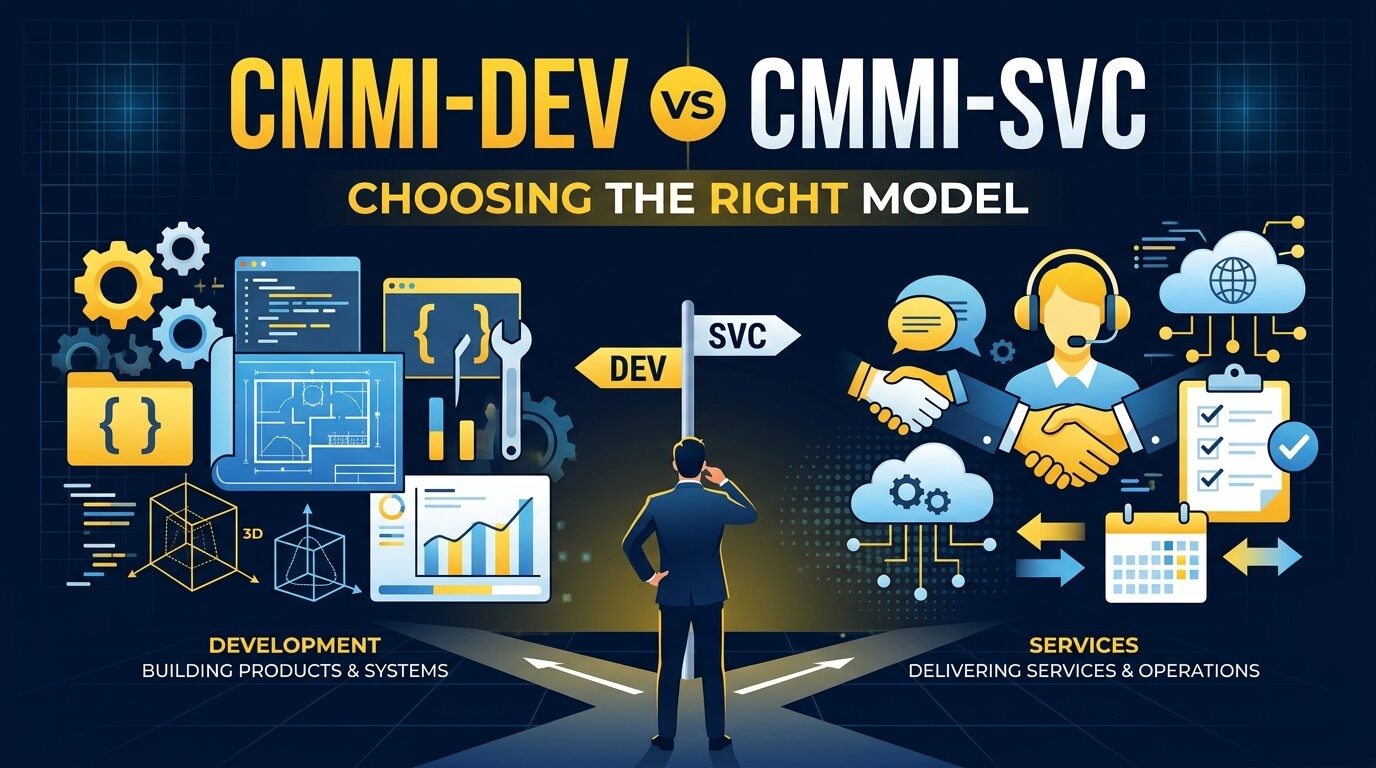
Organizations that want to improve operational performance, strengthen process consistency, and demonstrate their capabilities need to select an improvement approach that aligns with their business activities. The Capability Maturity Model Integration (CMMI) framework offers organizations a structured way to assess and improve processes. However, selecting the appropriate model or domain is an important early decision. For organizations comparing CMMI-DEV vs CMMI-SVC, the primary consideration is whether their main focus is developing products and solutions or delivering services to customers.
CMMI-DEV focuses on development-related activities, including the processes used to build, integrate, verify, and deliver products or solutions. CMMI-SVC focuses on service delivery and the processes needed to plan, provide, manage, and improve services. Both can support process improvement, but their relevance depends on the organization's operating model, customer commitments, risks, and strategic priorities.
This guide explains the differences between CMMI-DEV and CMMI-SVC, identifies the organizations that may benefit from each, and outlines practical considerations for choosing the right approach. It also explains how organizations can prepare for CMMI process improvement and a formal appraisal without treating the two models as interchangeable or assuming that one is automatically better than the other.
What Is CMMI-DEV?
CMMI-DEV refers to the development-focused model or domain within the CMMI framework. It is relevant to organizations that create, engineer, configure, integrate, or maintain products and solutions. Its emphasis is on establishing reliable development processes, managing technical and project risks, improving product quality, and making development outcomes more predictable.
Development organizations often manage complex requirements, changing specifications, design decisions, technical dependencies, testing activities, and release schedules. Without well-defined processes, teams may experience inconsistent delivery, recurring defects, scope changes, missed milestones, or difficulties reproducing successful results across projects.
A development-focused CMMI improvement initiative helps an organization examine how its work is planned and performed, identify process weaknesses, and establish practices that support consistent execution. The objective is not simply to document procedures. It is to improve how teams deliver products and solutions while aligning development activities with customer needs and organizational objectives.
Who Should Consider CMMI-DEV?
CMMI-DEV may be appropriate for organizations whose core work involves designing, developing, engineering, integrating, or maintaining products and technical solutions. Examples include:
- Software development companies building business applications, enterprise platforms, mobile applications, or digital products.
- IT product companies developing proprietary software, platforms, and technology solutions.
- Engineering organizations designing and developing technical products or systems.
- Organizations managing complex product development projects with multiple teams and technical dependencies.
- Technology providers seeking to improve requirements management, development quality, verification, validation, and release consistency.
For example, a software company that repeatedly experiences unclear requirements, inconsistent coding practices, late-stage defects, and unpredictable releases may benefit from a development-focused improvement initiative. By strengthening its development processes, the organization can work toward better traceability, more effective risk management, and improved control over project outcomes.
What Is CMMI-SVC?
CMMI-SVC refers to the services-focused model or domain within the CMMI framework. It is relevant to organizations that provide services to customers or internal stakeholders and need consistent methods for planning, delivering, monitoring, and improving those services.
Service organizations must coordinate people, resources, service commitments, customer expectations, operational risks, and performance requirements. Their success depends not only on completing individual tasks but also on providing services reliably over time. Weak service processes can lead to missed service commitments, inconsistent customer experiences, unresolved incidents, poor resource utilization, and repeated operational problems.
A service-focused CMMI improvement initiative helps organizations assess how services are planned, delivered, controlled, and improved. It supports the development of repeatable practices that can strengthen service quality, operational consistency, customer satisfaction, and the management of service-related risks.
Who Should Consider CMMI-SVC?
CMMI-SVC may be suitable for organizations whose principal business activity is providing, operating, or supporting services. Examples include:
- IT service providers delivering managed services, technical support, or outsourced IT operations.
- Business process outsourcing (BPO) companies managing ongoing services for client organizations.
- Technical support providers responsible for maintaining service commitments and resolving customer issues.
- Organizations delivering recurring professional, operational, or technology-enabled services.
- Service businesses seeking more consistent delivery, stronger operational controls, and measurable service improvement.
Consider an IT services company that manages customer infrastructure and provides ongoing technical support. Its challenges may include inconsistent incident handling, unclear responsibilities, inefficient resource allocation, and difficulty meeting agreed service commitments. A service-focused process improvement initiative can help the organization establish more consistent delivery and strengthen its ability to monitor and improve service performance.
CMMI-DEV vs CMMI-SVC: Key Differences
The central difference between CMMI-DEV and CMMI-SVC is the type of work each is intended to address. CMMI-DEV emphasizes development processes, while CMMI-SVC emphasizes service processes. The most appropriate choice depends on the organization's primary activities and the processes included in its improvement or appraisal scope.
1. Primary Business Focus
CMMI-DEV is generally aligned with creating or improving products and solutions. CMMI-SVC is generally aligned with delivering and managing services. An organization should identify whether its main challenge concerns how it develops a product or how it provides an ongoing service.
2. Process Improvement Priorities
A development-focused initiative may prioritize requirements, technical work, product integration, verification, validation, and release readiness. A service-focused initiative may prioritize service planning, delivery consistency, operational management, customer commitments, resource coordination, and ongoing improvement. The exact practices applied depend on the model version, selected scope, and organizational context.
3. Typical Performance Challenges
Development teams may struggle with defects, unstable requirements, rework, inconsistent engineering practices, and unpredictable delivery schedules. Service teams may face missed commitments, inconsistent support, repeated incidents, resource constraints, and variations in service quality. These are common examples rather than exclusive categories; organizations may experience both sets of challenges.
4. Expected Business Outcomes
CMMI-DEV can help development organizations improve the consistency and control of product or solution development. CMMI-SVC can help service organizations strengthen the consistency and management of service delivery. In either case, meaningful results depend on leadership commitment, employee participation, implementation quality, and the organization's ability to measure and sustain improvements.
5. Customer and Contractual Requirements
Some customers, procurement teams, or contracts may specify particular CMMI-related expectations. Organizations should review the exact requirement, including the applicable model version, domain, maturity or capability expectations, appraisal scope, and validity conditions. Choosing a model solely because it is widely recognized may not satisfy a specific contractual requirement.
How to Choose Between CMMI-DEV and CMMI-SVC
Selecting the right approach requires more than looking at an organization's industry label. A software company may also deliver managed services, while an IT service provider may develop proprietary tools. The selection should reflect the actual processes, business objectives, and appraisal requirements rather than the company name alone.
Step 1: Identify Your Core Business Activities
Begin by examining how your organization creates value for customers. Determine whether your main activities involve developing products or software, engineering solutions, operating services, providing technical support, or delivering recurring services under defined commitments.
If the organization primarily develops software or technical products, CMMI-DEV may be the more relevant starting point. If it primarily delivers ongoing IT or business services, CMMI-SVC may be a better fit. This initial decision should be validated against the current CMMI model structure and the organization's intended scope.
Step 2: Define the Business Problem You Want to Solve
Identify the performance problems that have the greatest impact on your business. Development-related issues may include frequent rework, inconsistent requirements, defects, or delays. Service-related issues may include inconsistent delivery, missed commitments, unresolved operational problems, or inadequate performance monitoring.
Clear problem statements help ensure that process improvement is linked to measurable business needs. They also help management determine which teams, functions, and processes should be included in the improvement initiative.
Step 3: Review Customer and Tender Requirements
Before selecting a model, examine customer expectations, tender documents, procurement criteria, and contractual commitments. Confirm whether the requirement refers to development, services, another relevant CMMI domain, a specific maturity level, or a defined appraisal scope.
If a contract explicitly names a model or domain, verify the requirement before investing in implementation. A process improvement initiative should support both operational needs and the conditions under which the organization intends to demonstrate its capabilities.
Step 4: Assess Existing Processes and Evidence
Review current procedures, work products, performance records, project documentation, service reports, risk management activities, and employee responsibilities. Determine which processes are consistently implemented and which depend heavily on individual knowledge or informal practices.
A gap assessment can help the organization identify strengths, weaknesses, and priorities before selecting detailed improvement activities. It can also reduce unnecessary documentation by highlighting where existing practices already support the intended objectives and where genuine changes are required.
Step 5: Confirm the Model Version and Appraisal Scope
CMMI model structures and appraisal requirements can evolve. Organizations should confirm the applicable model version, relevant domain or view, appraisal method, and scope with qualified CMMI professionals before finalizing their plans.
The appraisal scope should reflect the organizational unit and processes that need to be evaluated. It should not be selected solely to make preparation easier if doing so would fail to address the business requirement or the organization's actual operations.
Can an Organization Need Both CMMI-DEV and CMMI-SVC?
Yes. Some organizations develop products and also provide ongoing services related to those products. For example, a technology company may develop a software platform, deploy it for customers, provide technical support, and manage its operation after deployment. Its development activities and service delivery activities may have different process improvement needs.
In such situations, an organization should not assume that one domain automatically covers every process. It should map its development and service activities, identify the relevant requirements, and determine whether one focused improvement initiative or a broader approach is more appropriate.
The decision to address both areas should be based on business priorities, resources, customer expectations, and the applicable CMMI model structure. A combined approach may offer broader process coverage, but it can also require more coordination, employee time, management attention, and preparation. A phased approach may be more practical when the organization has limited resources or needs to address one critical business area first.
CMMI-DEV vs CMMI-SVC: Practical Business Examples
Example 1: Software Product Development Company
A software development company builds customized enterprise applications for business customers. Its teams face changing requirements, inconsistent project planning, repeated defects, and unpredictable delivery timelines. The organization wants to improve development discipline and establish more consistent methods for managing technical work.
CMMI-DEV may be a suitable starting point because the principal objective is to improve how software products and solutions are developed. The company can examine requirements management, planning, technical implementation, verification, validation, risk management, and other relevant processes according to the applicable model and scope.
Example 2: Managed IT Services Provider
An IT services provider manages infrastructure, supports customer systems, and delivers ongoing technical services under contractual commitments. Its main challenges include inconsistent service procedures, unclear escalation responsibilities, repeated incidents, and difficulty tracking service performance.
CMMI-SVC may be the more relevant starting point because the business depends on reliable service delivery and operational management. The organization can assess how services are planned, provided, monitored, and improved, while identifying the processes needed to support consistent customer outcomes.
Example 3: Software Company with Managed Services
A technology company develops its own software and also provides implementation, hosting, maintenance, and customer support. The development team is responsible for creating and updating the product, while the service team is responsible for supporting customers and maintaining agreed service commitments.
The company should review both sets of activities before making a decision. A development-focused approach may address weaknesses in product creation, while a service-focused approach may address weaknesses in ongoing delivery. Depending on its business objectives and appraisal requirements, the organization may need to prioritize one area or plan for both.
Preparing for CMMI Process Improvement and Appraisal
Choosing the appropriate CMMI model or domain is only the beginning. Organizations also need a structured implementation plan that connects process improvement to actual business operations. Preparation should focus on establishing effective processes, implementing them consistently, evaluating results, and ensuring that employees understand their responsibilities.
Establish Management Commitment
Senior management should define the objectives, allocate resources, assign responsibilities, and communicate why process improvement matters. Without visible leadership support, teams may treat the initiative as a documentation exercise rather than an opportunity to improve business performance.
Conduct a Gap Assessment
A gap assessment compares current organizational practices with the relevant model expectations and improvement objectives. It helps identify missing practices, inconsistent implementation, process weaknesses, and areas where existing evidence may be insufficient. Findings should be prioritized according to risk, business impact, and the intended scope.
Develop and Implement Processes
Organizations should establish practical processes, role definitions, guidance, and work products that support their selected objectives. Procedures should be appropriate for the size and complexity of the organization. Overly complicated documentation can create unnecessary overhead, while processes that are too informal may fail to provide consistent control or sufficient evidence of implementation.
Train Employees and Process Owners
Employees need to understand how the updated processes affect their daily work. Training should explain responsibilities, required activities, evidence expectations, escalation paths, and methods for reporting issues. Process owners should be able to monitor implementation and support teams when problems arise.
Monitor Performance and Address Gaps
Relevant measures help organizations understand whether processes are working as intended. Depending on the business, measures may include development rework, defect trends, delivery predictability, service performance, incident recurrence, customer feedback, or adherence to commitments. The selected measures should support management decisions rather than simply increase reporting activity.
Plan for a Formal Appraisal
When an organization intends to pursue a formal CMMI appraisal, it should confirm the applicable requirements, scope, schedule, and arrangements with appropriately qualified CMMI appraisal professionals. Preparation should demonstrate how processes operate in practice, supported by relevant evidence and participation from the people who perform the work.
Consulting, training, and readiness support can help organizations understand requirements and address gaps. However, an appraisal outcome should never be guaranteed in advance. The result depends on the applicable appraisal process, the evidence evaluated, and the organization's demonstrated performance against the relevant requirements.
Common Mistakes When Choosing a CMMI Model
Organizations can lose time and resources when model selection is based on assumptions rather than a clear assessment of business needs. The following mistakes are worth avoiding:
- Selecting a model based only on the organization's industry instead of reviewing its actual development and service activities.
- Assuming CMMI-DEV and CMMI-SVC are interchangeable in every business context.
- Ignoring tender requirements, customer expectations, or the model version specified in a contract.
- Treating process improvement as a documentation project instead of improving how work is performed.
- Starting appraisal preparation without defining the organizational scope, responsibilities, and required evidence.
- Expecting a particular maturity outcome without first understanding the applicable requirements and addressing process gaps.
Avoiding these mistakes helps organizations make more informed decisions, focus resources on the right processes, and develop a realistic roadmap for sustainable improvement.
How B-ADVANCY Can Support Your CMMI Journey
B-ADVANCY is a global certification and sustainable business assurance company providing consulting, professional training, audits and inspections, and management system-related services. Organizations exploring CMMI process improvement can benefit from a structured approach that begins with business objectives, evaluates existing processes, and identifies practical steps toward improved organizational capability.
Support may include understanding the organization's development or service delivery needs, reviewing current process maturity, identifying gaps, building employee awareness, improving process documentation, and preparing teams for an appraisal pathway appropriate to their objectives. The scope of support should be agreed in advance and aligned with the applicable CMMI model and requirements.
Organizations should independently confirm the qualifications and authorization of any professional or organization engaged to conduct a formal CMMI appraisal. Consulting and readiness assistance should be distinguished from the formal appraisal itself, and no specific appraisal outcome should be assumed or guaranteed.
Whether your organization develops software products, provides managed IT services, or operates a combined business model, the first step is to understand your process challenges and define the outcomes you want to achieve. A well-planned improvement initiative can help establish clearer responsibilities, more consistent execution, stronger performance monitoring, and a foundation for ongoing improvement.
Conclusion: Which CMMI Model Is Right for Your Organization?
The choice between CMMI-DEV vs CMMI-SVC depends on what your organization does, which processes it needs to improve, and what its customers or contracts require. CMMI-DEV is generally more relevant when the main focus is developing products and solutions. CMMI-SVC is generally more relevant when the main focus is planning, delivering, managing, and improving services.
Organizations that develop products and provide ongoing services may need to assess both areas and determine the most appropriate scope or sequence. A careful gap assessment, clear business objectives, employee involvement, and qualified appraisal guidance can help reduce uncertainty and establish a practical improvement roadmap.
Ultimately, the best choice is not necessarily the model with the broadest reputation. It is the approach that aligns with your organization's real work, supports customer and contractual expectations, and helps improve business performance in a measurable and sustainable way.
Contact B-ADVANCY to discuss your process improvement objectives and determine the appropriate next steps for your organization.

 Contact For Services
 Explore Training Calendar